“Where were you on September 11, 2001?” For anyone old enough to remember, the question has an immediate and visceral answer. But how about the day after? Or the day after that?
In the haze of grief, shock, and anger that descended over the country, Americans struggled to grapple with what had just happened and what to do next. Everyone wanted to do something, but what?
Government and military leaders were quick to mobilize for war against an unclear enemy. At the same time, FCNL and its network were already urging peace, along with other advocates across the country who were exercising prophetic witness against the wars that were to come.
Remarkably, two of these efforts for peace have continued on to the present day – week after week for more than 25 years.
The Cleveland peace vigil began to gather shortly after the attacks in September 2001, made up of a variety of religious groups including Quakers and Catholic Workers. Though smaller today, a group still meets at the West Side Market every Saturday, defying rain and snow to witness against the seemingly endless cycles of conflict.
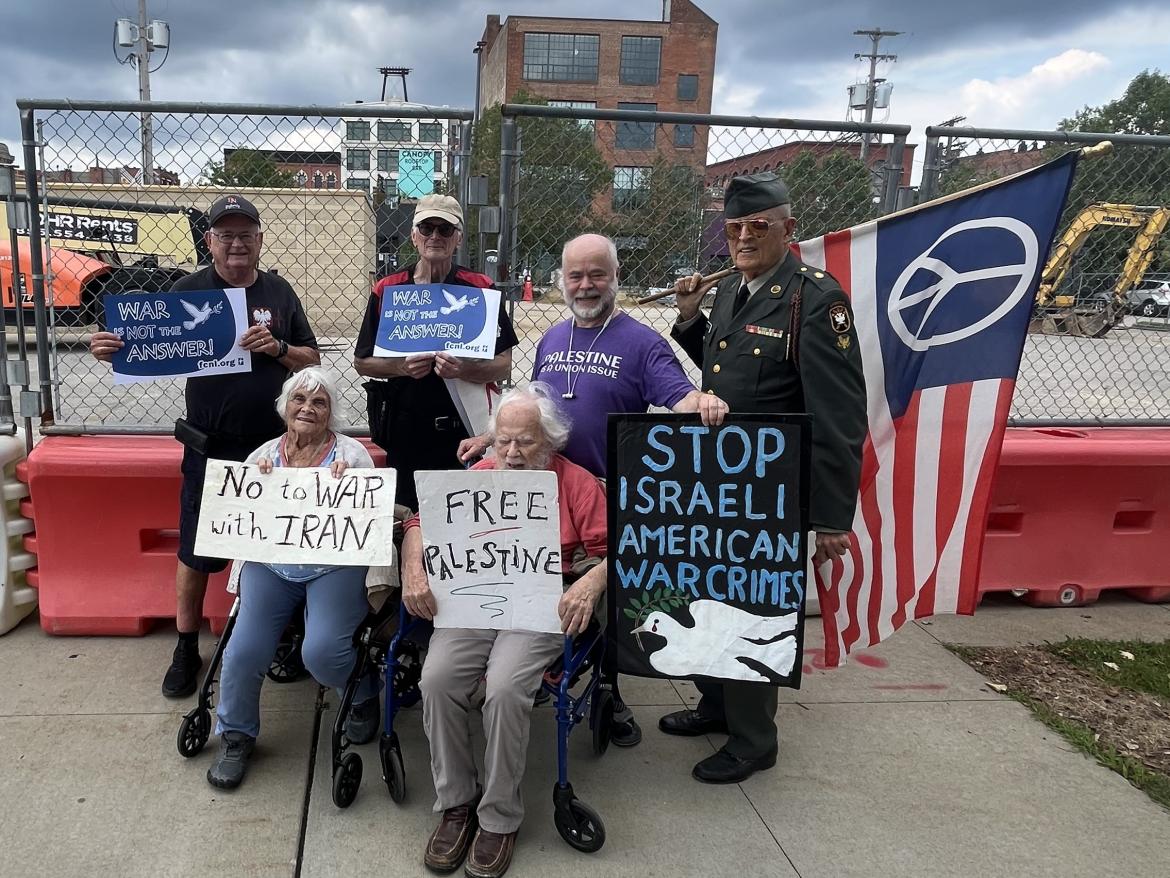
Tom Nowel has been part of the vigil since 2010. His pacifist convictions and peace activism predate his membership in the Religious Society of Friends. Nowel says that his Quaker faith “gave more meaning to my belief that ‘war is not the answer.’ There is that of God in everyone.”
About 700 miles south of Cleveland, another group of activists in Birmingham, Alabama were driven by the same urge to do something in the fall of 2001. Their vigil had actually started before 9/11 to oppose sanctions on Iraq. Shelley Douglass, one of the original organizers, says that “when it became clear that Bush was intent on going to war we decided to intensify our own actions.”
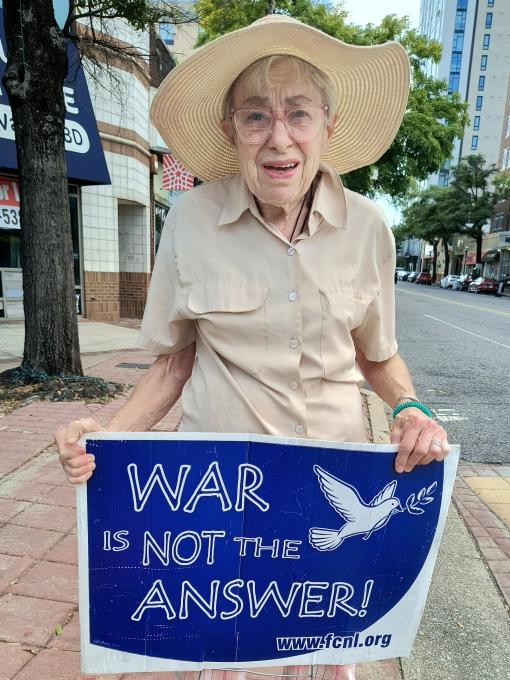
Several faiths are represented at the Birmingham vigil, including Buddhism, Judaism, and Unitarianism along with several Christian denominations. Douglass is a Catholic Worker herself, and sees particular alignment with Friends in values of nonviolence and peacemaking.
Neither of the vigils are large groups. Their power is not in their size, but in what holds the center. Members have come, gone, and come, anchored by the message of peace that has been publicly delivered each week at markets and intersections for over two decades.
For Douglass and Nowel, that persistence is informed by their spiritual beliefs: defending the sacredness of human life, opposing the catastrophic violence of war, and translating faith into action.
In addition to a time of remembrance, the way we commemorate September 11 should also take stock of all that came after. If “war is not the answer,” as we’ve discovered from the violence that was created and intensified after 9/11, then what is the answer?
Just like the vigils, you might find answers and lessons in the days that follow. The International Day of Peace celebrated its 45th anniversary on September 21. The International Day of Non-Violence is celebrated on October 2, Mahatma Gandhi’s birthday. At a time of growing geopolitical tension, these days of observation matter. They should call us to widen our perspective beyond the national tragedy of 9/11 to the international impact of our county’s response.
As we mark 25 years since the start of the “Global War on Terror,” how can we see through that haze of grief and anger that drives us to keep the cycles of violence going? The attendees of the Cleveland and Birmingham vigils may agree with Gandhi that “Truth is my God. Non-violence is the means of realizing Him.”
