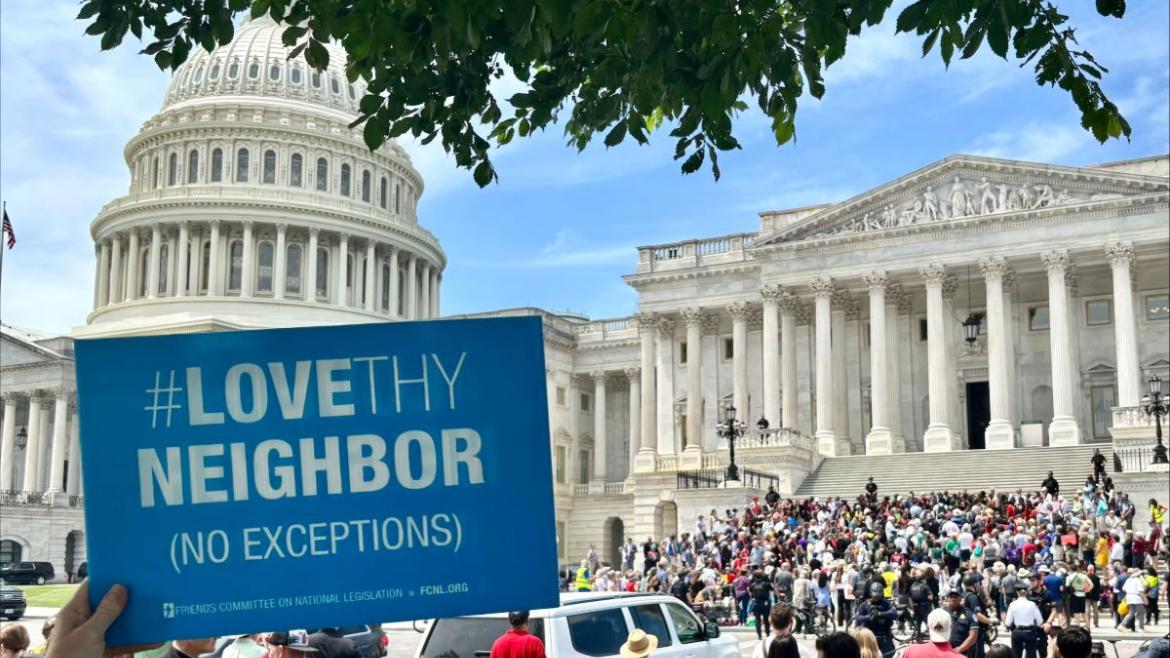
As the House and Senate begin to reconcile differences within their respective versions of the FY27 National Defense Authorization Act (FY27 NDAA), the Friends Committee on National Legislation wrote to share our recommendations for conference negotiations.
October 16, 2026
Dear Senator or Representative,
As the House and Senate begin to reconcile differences within their respective versions of the FY27 National Defense Authorization Act (FY27 NDAA), the Friends Committee on National Legislation writes to share our recommendations for conference negotiations. As a Quaker-led organization and the oldest registered faith-based lobby on Capitol Hill, we underscore the importance of adopting a moral lens when considering our nation’s national defense. The defense policies we craft and the investments we approve are reflections of our national values and the future we seek to build.
It is not a time for business as usual as the United States continues to pursue a deeply unpopular and unauthorized war in Iran. This war is costing American taxpayers more than $1 billion per day and increasing fuel prices for working families, while fueling widening violence and instability that threatens U.S. personnel and civilians across the region. We appreciate and support members of Congress pressing for an immediate and permanent ceasefire and taking steps to prohibit funds from being used to sustain the war without Congressional authorization.
At the same time, we urge you to take steps to ensure that any final NDAA bill:
- Limits U.S. military integration with and support to foreign partner countries engaged in patterns of gross human rights abuses;
- Halts dangerous new testing and development of theater-range nuclear weapons and weapons delivery systems; and
- Mitigates mounting risks posed by the integration of Artificial Intelligence into military and weapons systems.
Specifically, we urge you to consider the following recommendations related to NDAA provisions in the House and/or Senate versions:
- U.S.-Israel Military Cooperation: OPPOSE Section 1217 of S. 4784 and Section 219 of H.R. 8800. These provisions would create a U.S.-Israel Defense Technology Cooperation Initiative within the Department of Defense and direct the Secretary of Defense to accelerate the integration of Israeli-origin technologies into U.S. weapons systems and programs of record. This would be an unprecedented integration of the U.S. defense industry with that of a foreign nation. This is especially troubling while humanitarian aid to Gaza remains blocked and settlers and Israeli security forces continue to commit human rights violations. Congress should be pursuing accountability, not deeper entanglement. We urge you to oppose these provisions and strike them from the final conference text.
- Nuclear Weapons Testing and Development: OPPOSE Section 1521 in S.4784. This section authorizes programs to research, develop, and produce two new or modified theater-range nuclear weapons and weapons delivery systems. Theatre-range weapons, otherwise known as “tactical” nuclear weapons, increases the risk of nuclear weapons being used in a conflict. Countering the threat of tactical nuclear weapons should prioritize diplomatic efforts to contain new weapons under arms control agreements. Continuing to expand our nuclear arsenal with new types of weapon systems encourages a global arms race. Congress must reject this provision to avoid lowering the threshold of nuclear weapons use.
- Risks Posed by AI in Military Systems: SUPPORT Section 1089, 1502, and 1524 in H.R.8800 AND Section 1653 in S.4784. Section 1089 requires the development of a military doctrine for the deployment of unmanned autonomous systems, including system compliance with safety and legal standards. Critically, subsection G requires public reporting on the results of a civilian harm investigation relating to the Shajareh Tayyebeh Elementary School strike, which killed 156 people. The other three sections require the Department of Defense to preserve an identifiable chain of command for use of force actions that retain human control over system outputs, to update policies that improve safeguards and increase testing on autonomous and AI-enabled systems, and to create an AI incident reporting program. Maintaining human accountability and placing guardrails on system use is necessary to curb the ability of emerging technologies to cause harm.
Additionally, we urge any NDAA to prevent the diversion of U.S. military resources, facilities, and personnel to immigration enforcement, arbitrary domestic deployments, or related civilian law enforcement, affirming that military power should not be used as a tool of domestic enforcement.
FCNL seeks a society free from discrimination, whether due to race, creed, sexual orientation, or gender identification or expression. In this regard, we further urge Congress to oppose any provision of the NDAA that violates or infringes on the human rights or dignity of racial, religious or sexual and gender minorities.
Thank you for your thoughtful consideration and your work to ensure that our defense policies meet the highest ethical standards and position the United States to build the peace we need, especially to guard against unnecessary U.S. involvement in overseas wars and global arms races. We wish you wisdom and courage as you make consequential choices regarding this bill and the future of our country.
Sincerely,
Friends Committee on National Legislation
Join our email list!
Stay informed and stay active