Every generation has experiences that divide their lives into “before” and “after.” September 11, 2001 is mine. It came as I was beginning my adult working life, and the people I experienced it with helped shape who I am and what I do today.
On 9/11, I had just started my second year at FCNL as a program assistant. It was a gorgeous fall day, sunny and finally cool – still, I think of early fall in Washington, DC as “9/11 weather.”
I left my apartment in South Arlington, near the Pentagon, and headed downtown for a coalition meeting. As we gathered, there were rumblings of something going on. Someone left the room to check the television and saw the towers fall in New York, heard about the Pentagon. Rumors were flying – was the Metro safe? What other buildings in DC were targets?
I tried calling the FCNL office a couple of times from the coalition partner’s landline, but nobody answered.
I didn’t yet have a cell phone. I tried calling the FCNL office a couple of times from the coalition partner’s landline, but nobody answered. I learned later that everyone had evacuated to a staff member’s house a few blocks away, where they stayed in the basement watching what was unfolding on TV. All I could think about was getting home.
That was easier said than done. Traffic was not moving, and cabs were not stopping. I stood on the street comparing notes with others, figuring out who could share rides if someone stopped. I wound up in a cab with a defense contractor who could identify all the military planes flying overhead. The bridges into Arlington were all closed; once we made it through the gridlock of downtown, we drove around the Beltway to come in from the west.
When I finally got out of the cab, everything seemed normal – at least, until I turned down my street and saw (and smelled) the smoke billowing from the Pentagon, just a mile away. The rest of the day was spent checking in with people, trying to discover what was happening and make some sense of it.
And then came the next day, September 12. FCNL was open. I took a deep breath and got on the Metro at Pentagon City, the air still thick with burning airplane fuel.
I don’t remember many details of the work that day, or in the weeks that followed. Joe Volk, the executive secretary, was in Iowa visiting supporters and struggling to get home with disruptions in air travel. FCNL issued staff IDs, so we could get to the building if Capitol Hill streets were shut down. As a staff, we periodically gathered in centering worship.
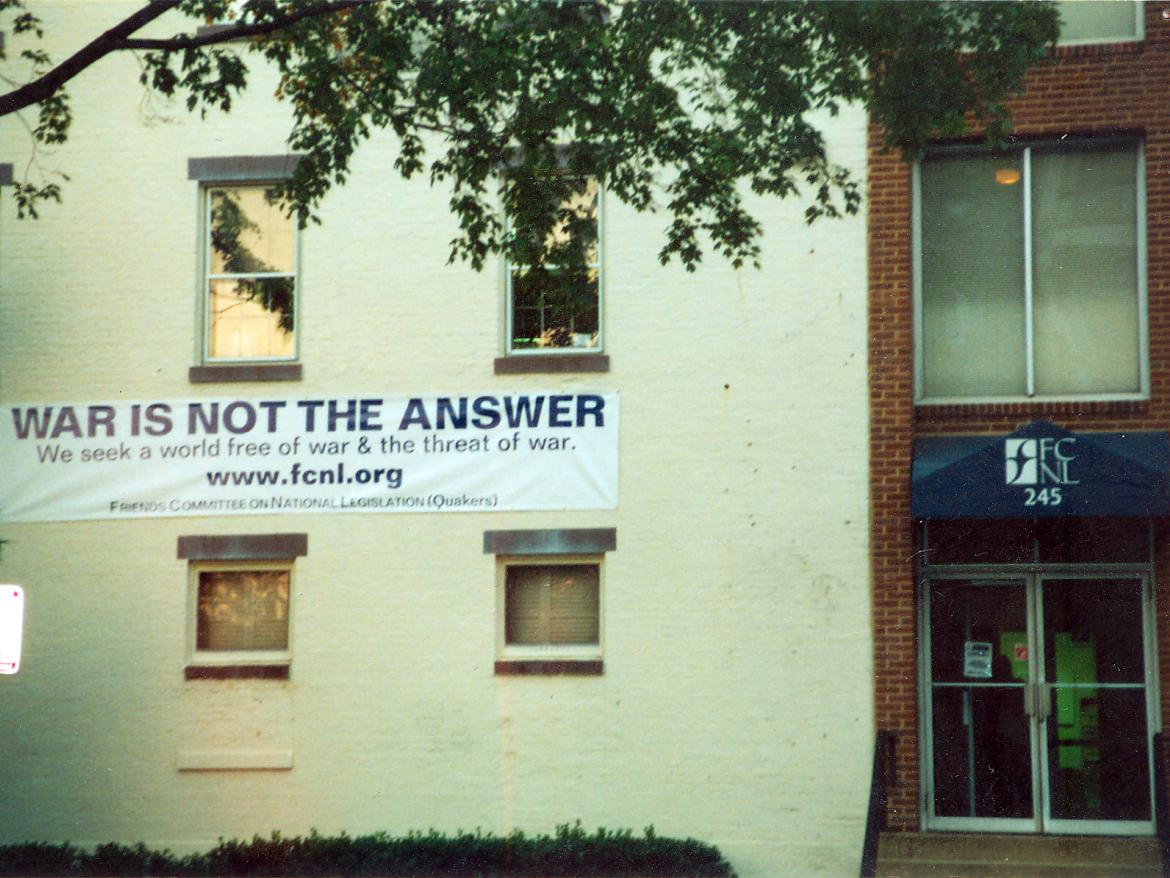
As the country rushed towards war, FCNL hung a banner that said “War Is Not the Answer” on its building, across from the Senate. My work shifted away from domestic policy and almost entirely into communications, as the organization diverted resources to the country’s response to the attacks.
Only gradually did I come to appreciate the clarity with which FCNL and its leaders acted amidst this tragedy. Out of all the fear, anger, grief, and worry of that day, on September 12, 2001 FCNL issued a statement (authored in large part, I believe, by FCNL Legislative Secretary Ned Stowe) that cut through everything to speak truth. It reads, in part:
Many in the administration and Congress have declared that a state of war now exists.… We wonder: War against whom? Cooler heads must prevail in the U.S. government during this time of crisis. War will only compound the tremendous assault on humanity that has already occurred. War is not the answer. The people who committed these acts struck with hatred.… The U.S. must not commit the same sin by compounding the hatred, violence, and injustice of these attacks with its own acts of terror and war against another people, most of whom are innocent of these crimes…
As members of the Religious Society of Friends (Quakers) we witness to that spirit of love which takes away the occasion of war. Out of darkness and tragedy, may God show us the path of true and lasting peace.
Although I was working at FCNL and occasionally attending Quaker meeting, at this point in my life I was not yet a Quaker. A big part in my convincement came from this experience of working at FCNL through 9/11.
Here were people who listened deeply and spoke out of what they heard from Spirit, even when it went against the prevailing sentiments – on Capitol Hill, in Washington, DC, and even among some Friends. (As one of my coworkers quipped at the time, “Being a pacifist between wars is like being a vegetarian between meals.”) Here was an organization that supported the courageous acts of speaking and listening, had the capacity to do what it discerned was right, and trusted that way would open.
As my journey continued as a Friend, and I had the chance to return to the FCNL staff, I have tried to carry forward FCNL as an organization capable of acting from principle and revealed truth, of weighing conventional wisdom against these factors, and embodying Quaker faith and practice in its own unique and necessary way.