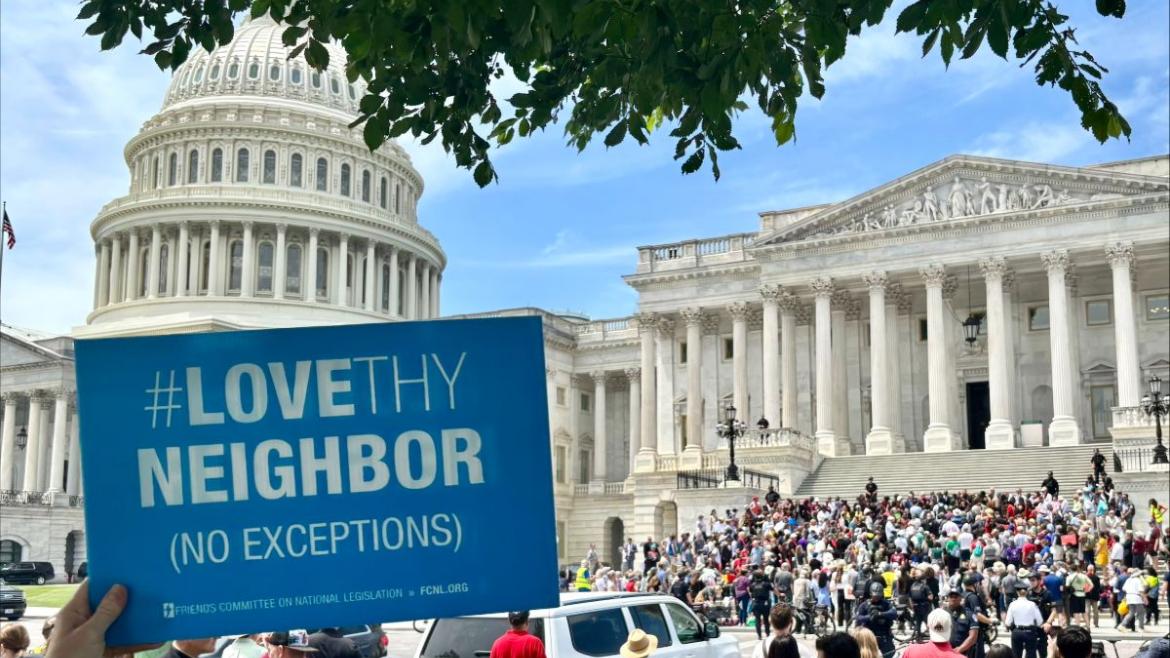
This was the question FCNL faced nearly two decades ago. The “War is Not the Answer” movement had sparked widespread energy, and members of FCNL’s General Committee and staff were ready to build on that momentum.
Among them was Jim Cason, former associate general secretary for policy and advocacy, who came to FCNL with a leading to engage more people in the political process. When Diane Randall became general secretary, she shared a vision to deepen FCNL’s advocacy. By then, Annual Meeting already included lobbying, with many arriving early to participate.
As Cason recalled, Randall asked, “Why not make lobbying an expectation?” The network enthusiastically responded.
Through deep listening and building on past efforts, FCNL established the Advocacy Teams network in 2015 to make this vision real.
Today, the network includes 1,500 Quakers and friends in 135 teams—now in all 50 states and the District of Columbia. They lobby congressional offices, publish in local media, and organize community events to advance peace and justice, grounded in a commitment to mutual respect and listening.
The power of Advocacy Teams lies in their simplicity. “The most energizing part of this work,” said Tim Heishman, who leads the program, “is helping people realize they can use their voice for change. With a little training and the right tools, they see they can make a real difference—and that gives me hope for our democracy.”
Nancy Bermon, from the Stony Point, NY, team—FCNL’s 32nd—recently shared how her region had grown to more than eight teams. They regularly coordinate their advocacy across the state.
FCNL has cultivated similar statewide networks of Advocacy Teams, a practice that is expanding and deepening the impact of the program.
The grassroots momentum continues to grow. Susan Burt of Normal, IL, had known of FCNL since becoming a Quaker in 1980 but only learned about Advocacy Teams two years ago during an FCNL discussion of the book, Light in Gaza. When she heard the 2025 campaign would focus on a Gaza ceasefire, she was moved to act.
Burt brought the idea to her meeting and to friends. Working from a list of 23 committed individuals, they launched the Normal, IL, Advocacy Team early this year. The team now includes Friends, Methodists, Mennonites, Catholics, Unitarians, and unaffiliated advocates. Heishman called her swift organizing “an antidote to despair.”
“If there is anything that is constant about Quakerism, it is needing to be open to continuing revelation. That means being courageous enough to know that we need to continue changing and evolving and responding to the needs that the world has.”
— General Secretary Bridget Moix
Each time Heishman and Burt checked in, she added more names to her list. Multiply her list by thousands of individuals and communities nationwide, and you begin to see the power of FCNL’s advocacy in action.
At FCNL’s 80th anniversary in 2023, General Secretary Bridget Moix reflected, “If there is anything that is constant about Quakerism, it is needing to be open to continuing revelation. That means being courageous enough to know that we need to continue changing and evolving and responding to the needs that the world has.”
LaVida Davis, FCNL’s director of strategic advocacy, views Advocacy Teams as the foundation of the organization’s work. But the program is far from static. In response to continuing revelation, the program has become more dynamic, adapting to meet increasingly complex challenges.
“Instead of one bill and one ask, the asks now shift,” Davis explained. “We’ve equipped advocates to adjust based on whether they’re lobbying the House or Senate, or to take on additional asks as needed.”
This year, Teams adopted a secondary campaign—on climate change—allowing them to stay active if they have extra capacity or if the primary issue does not resonate with their lawmakers.
Justin Hurdle, FCNL’s advocacy campaigns and stakeholder engagement manager, says this added flexibility strengthens team members as multi-issue advocates. It also increases the relevance of FCNL’s work with each member of Congress.
Several interviewees credited Tim Heishman and Eleni Sefanit Retta, Advocacy Teams organizer, for their leadership in shaping and supporting the program’s evolution—a reflection of the long-standing commitment to advocates across the country.
Alicia McBride, senior director of Quaker leadership, affirmed this: “Alongside building relationships and engaging across differences, being supported by the institution behind you is deeply powerful.”
That support and the relationships it fosters sustain this work. As Heishman put it, “Advocacy Teams show that we can persist because we’re not alone.”