On September 24, I joined other peace colleagues for a meeting with President Mahmoud Pezeshkian of Iran. It was the fourth year I represented FCNL in a meeting with the Iranian President on the sidelines of the United Nations General Assembly in New York and my second time meeting with President Pezeshkian, who was elected in 2024 after the more hardline President Ebrahim Raisi died in a helicopter crash. We met just days before the UN reimposed “snapback” sanctions on Iran and following months of escalating conflict and violence, including the Israel-Iran 12-day war and U.S. bombing of Iranian nuclear facilities.
Unlike past meetings with Iran’s President, which had been framed as interfaith dialogues and included a mix of Jewish, Muslim, and Christian perspectives, this discussion was titled “Voices for Peace: Preventing Another War in the Middle East,” and brought together a mix of organizations and individuals across the political spectrum with varying perspectives on U.S.-Iran relations but a common position that more war is not the answer.
President Pezeshkian joined the meeting after a busy morning at the UN, including his formal speech to the General Assembly and a meeting with French President Emmanuel Macron. Iran was engaged in urgent diplomacy with European and other countries to negotiate a deal that might prevent the snapback sanctions and reopen the possibility of a new nuclear deal. The Joint Comprehensive Plan of Action, or JCPOA, which had been agreed in 2015, was in tatters after the first Trump Administration withdrew the U.S. from it in 2018. Iran later began limiting access to its nuclear facilities for international inspectors.
Our discussion with Pres. Pezeshkian was notable for its openness and his willingness to take all our questions and engage on difficult issues.
Our discussion with Pres. Pezeshkian was notable for its openness and his willingness to take all our questions and engage on difficult issues. What I noticed most, though, was how human he seemed. He looked a bit tired and spoke passionately about the genocide in Gaza, noting how difficult it is to see the images of people, including children, being starved and killed each day while the world stands by and the U.S. supports Israel’s military campaign. He spoke of the assassinations of Iranian scientific, military, and political leaders in recent months by Israel, and of its attempted assassination against him. He expects there will be more attempts against his life.
It’s hard to know what to say in these meetings. In past years, we have given formal statements encouraging diplomacy and peace back and forth with little real dialogue. But this year felt different. Perhaps it was the shadow of Gaza, or how he seemed a little vulnerable, or the deliberate effort he and his foreign minister made to respond to each of our questions. Whatever had shifted, when I felt my heart begin that familiar quickened beat encouraging me to speak, I let myself say what I really wanted to say to him.
In past years, we have given formal statements encouraging diplomacy and peace back and forth with little real dialogue. But this year felt different.
I told him first that I was so deeply sorry and grieved at all the suffering that had occurred in Gaza, in Iran, in the U.S., across the world, since we had met last. I told him I was also grateful that we were all here together trying to find a path back to peace, and that we would continue doing all we can, even with the challenges of our current U.S. administration, to end U.S. complicity in the genocide in Gaza and resume diplomacy with Iran. And I reiterated the message of other colleagues that we need more people-to-people diplomacy between Iran and the U.S. as well, to help humanize one another and build relationships that can sustain connections between our countries no matter what our governments might do.
My colleague Hassan El-Tayyab, FCNL’s legislative director for Middle East policy, was also in attendance and shared updates on FCNL’s advocacy around Sen. Tim Kaine’s (VA) Iran War Powers Resolution, introduced in response to President Trump’s unauthorized strikes during the 12-day war, as well as our work to end the genocide in Gaza. Hassan urged the Iranian president to remain open to diplomacy with the United States, even in this difficult moment, noting South Korea’s President Moon’s commitment to “anytime, anywhere diplomacy” with North Korea as an example of strength rather than weakness. Hassan underscored the broader lesson that flexible, credible diplomacy can be a strategic asset. The President appeared to nod in agreement.
As we were wrapping up the meeting, I gave Pres. Pezeshkian an FCNL War Is Still Not the Answer bumper sticker, to go with the first War Is Not the Answer sticker I had given him last year, because, well, why not? He smiled and thanked me, and we even got a picture together afterward.
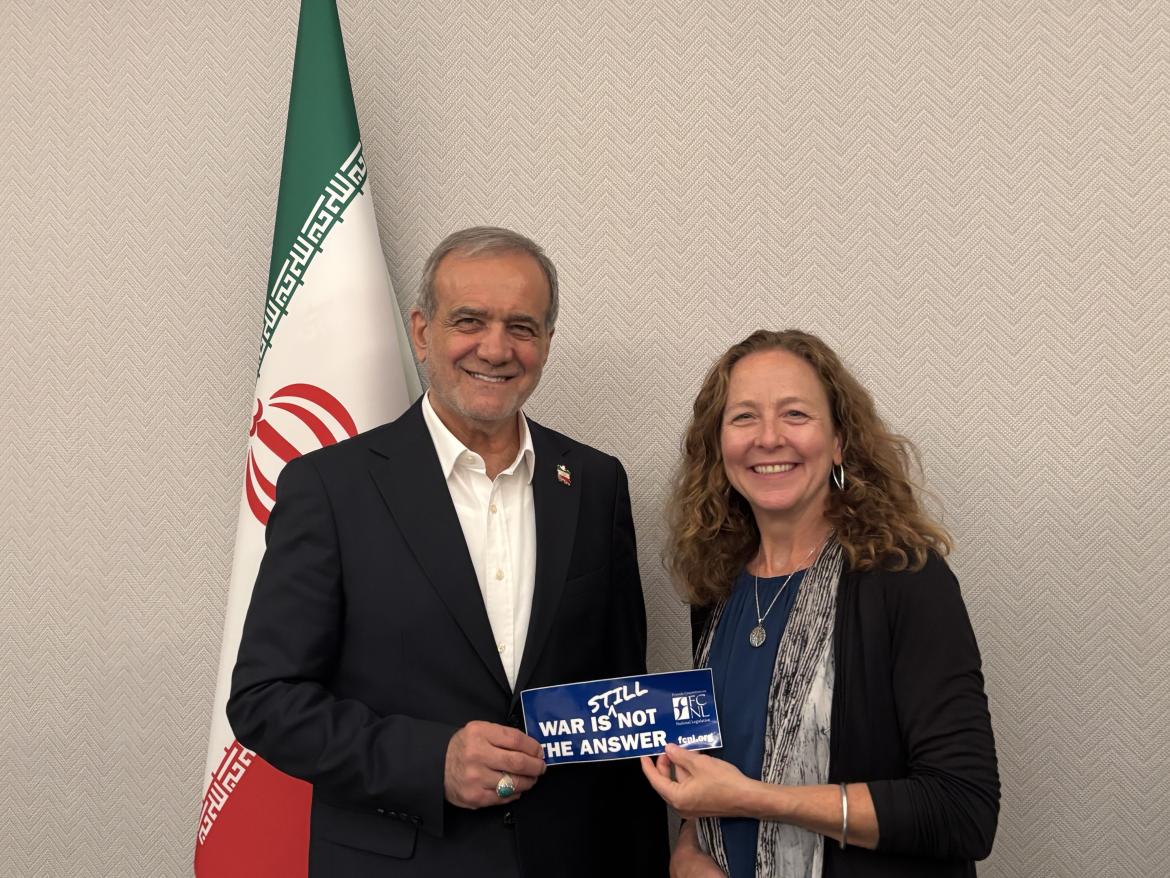
I don’t know if this meeting made any difference in helping prevent more war in the Middle East. U.S.-Iran relations are at a new low, efforts to avoid snapback sanctions failed, we are poised on the brink of global nuclear escalation, and Israel’s campaign of atrocities against Gaza continues. One meeting doesn’t seem like it can do much to undo all the damage in our world.
But, for me something remarkable did happen that reminds me that peace is always possible. Amid escalating war and enmity in global politics, we sat down to talk and listen to one another and, in the process, caught a small glimpse of our common humanity.
For more insights on our meeting with President Pezeshkian, watch this news report from a reporter who attended.
FCNL has been part of direct diplomacy with Iran for three decades.
