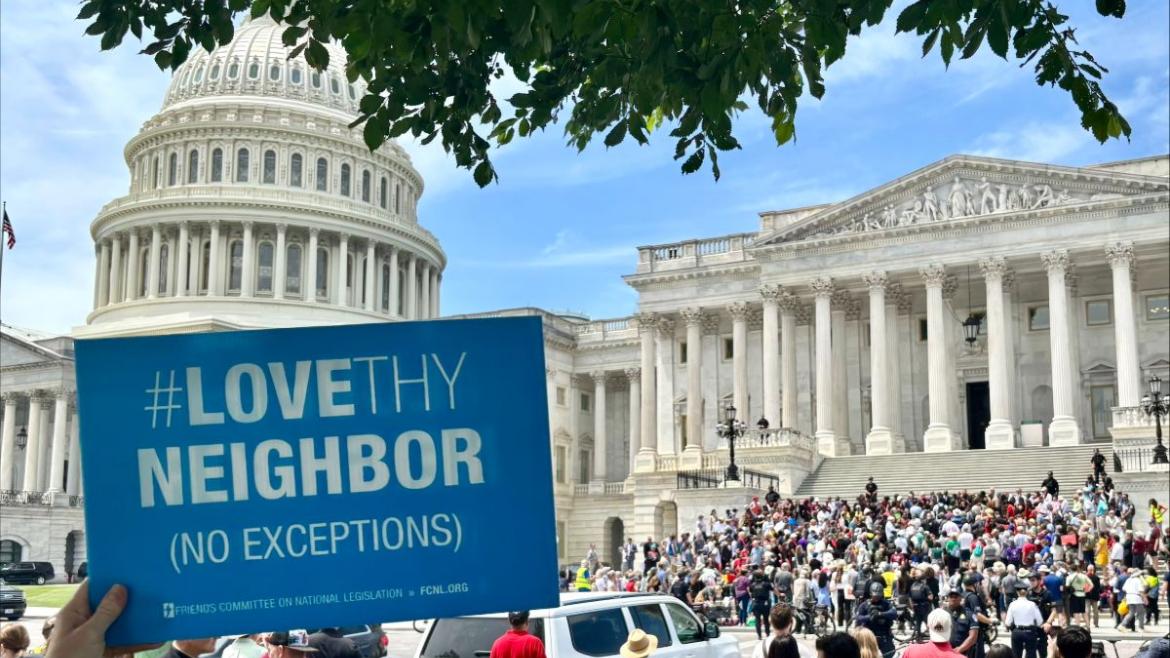
The 2025 World Quaker Day theme, Love Your Neighbor, invites us to consider what this advice means for each of us. Alicia McBride, Senior Director for Quaker Leadership, addressed this theme during a Pendle Hill First Monday lecture in November 2024. An edited excerpt is below, or you can watch the video of the full lecture with Alicia and FCNL’s justice reform lobbyist José Moreno.
As we consider our role of new systems, we are invited to engage in the spiritual practice of loving our neighbor without exception.
Let’s consider this word, love. We pack a lot of meaning into it. I sometimes think the Greeks have the right idea separating different kinds of love in their language. For example, eros is romantic love, agape is unconditional or selfless love, and philia is friendship. Actually, English makes these distinctions too. We talk about infatuation, empathy, compassion, fondness, devotion, adoration. “Love” comes with a hint, maybe an aftertaste of all of those flavors. Love doesn’t mean just one thing.
A sermon I heard years ago in an Episcopal church helped change my perspective on how we love our neighbors. The minister compared loving your neighbor to loving your sibling. It doesn’t mean you have to like them, or accept everything about them, or be vulnerable to them.
The invitation to love our neighbors becomes more actionable, more possible when I start substituting other words in for love. “Have compassion for your neighbor, without exception.” “Care about your neighbor, without exception.” “Act as if your life and your neighbor’s life are intertwined, without exception.” Even if you believe someone is wrong, can you still feel love for them?
Even if you believe someone is wrong, can you still feel love for them?
This way of relating to our neighbors gives us a foundation from which to act and moves us towards a more just democracy. As Cornell West says, “justice is what love looks like in public.” But don’t just take my word for it. This is a place where the wisdom of many different traditions comes together.
In the Torah, the New Testament, and the Qur’an, this advice is echoed. Even George Fox has his version: in a 1656 letter to ministers, he wrote “be patterns, be examples in all countries, places, islands, nations, wherever you come, that your carriage and life may preach among all sorts of people, and to them; then you will come to walk cheerfully over the world, answering that of God in everyone.” This feels like case where many people seem to be tapping into the same divine stream and bringing a similar message out of those living waters.
You might ask, how do we do it? We start by recognizing that it’s a spiritual practice, something we get better at by doing it. It’s a spiritual muscle that we strengthen, maybe even giving particular attention to those we find the most difficult. Also in the Bible, in the book of Matthew, we are told to love our enemies and pray for those who persecute us.
In Buddhism, there is a meditation known as metta or loving kindness. The invitation is to imagine a series of people or beings and speak a heartfelt desire for their happiness, health, safety and freedom from suffering. You’re invited to consider someone you love unconditionally, someone you have a hard time with, and yourself (which can be the hardest part sometimes). In our Quaker practices, we hold people in light, we experiment with light, we look for and speak to that of God and another person.
In this moment, how might you practice extending love, care, compassion to others whether you approve of their actions or sympathetic to them or not?
We also love our neighbors by recognizing that the power of this action comes not from changing them, but in changing us.
We also love our neighbors by recognizing that the power of this action comes not from changing them, but in changing us. I love Sandra Cronk’s description in “Peace Be With You: A Study of the Spiritual Basis of the Friends’ Peace Testimony.” She says, “God’s love may not be reduced to a technique to bring people around to one’s own point of view. God’s love, like the sunshine and the rain, is poured out on the just and unjust alike….the peace testimony does not assume naively that love will bring an immediate transformation in the hostile one. In fact, the decision to act in love may increase the aggression of the adversary, who now sees a chance to overpower us.”
Moving from a place of love may not be practical, it may not be effective, and yet it is what so many faith traditions including our own calls us towards.
In the fall of 2024, the Friends United Meeting newsletter featured a number of friends writing about their thoughts on the U.S .election. Fritz Weiss from Portland Friends Meeting summed up many of these directions: “I suggest that what these times require of us is our imagination, that we know our convictions, that we act with humbleness, that we hope without attachment to outcome and that we love.”
We love our neighbors without exception from a place of listening and humility. We’re not trying to fix others or project our own ideas what they need onto them. You can love someone even when they make decisions you don’t agree with or understand. We can love ourselves well enough not to enable those choices in ways that compromise our own sense of integrity. And we do it by recognizing that we can love someone and still not like them, still not endorse their point of view, still hold them accountable for the harm they might do. We can work relentlessly to defeat a political candidate or stop a policy or oppose a war and still be moved by an act with love for those we are working against.
So what does it look like to love our neighbors without exception as we work towards a just democracy?
In a congressional visit, if you are lobbying for the Freedom to Vote Act and speaking to a Republican member of Congress who has spoken out against this bill, what do you do? Part of it is what story you are telling in that visit the story of what you love enough, this country, the people in it, the ideals of our electoral system to upend your schedule, maybe travel a long distance, talk to someone you don’t expect to agree with you.
What about the person you’re meeting with? What does extending love, compassion, care look like? Former FCNL Legislative Director Ruth Flower used to talk about how, in her lobby visits, she remembered that God is was in the room, and in herself, and in the person she was meeting with. Can you see people who disagree with you not as obstacles or oppositions to love manifesting, but as a part of love’s intricate weaving? That still means you can disagree and challenge them, but it’s from a place that still recognizes their humanity.
Can you see people who disagree with you not as obstacles or oppositions to love manifesting, but as a part of love’s intricate weaving?
The more we practice loving our neighbors, the more it will feel possible to have love and compassion for those who feel differently than us, as well as those who do, and to manifest the complexity of that love to add to what’s available in the whole system. This kind of love is fierce. It’s heartbreaking. It’s messy and infinite and complicated. It is a practice we are working on our whole lives, not just a rule we follow or a series of rituals that we enact. This kind of love takes us out of our comfortable categorizations and desire for certainty. It can lead us to live lives of service to others and to be curious about others’ experiences. This kind of love asks us to challenge the perception that love is a scarce and finite commodity. Love is not oil or money or whatever other resource we guard in this late stage capitalism. Love is, in the words of the Malvina Reynolds song, a magic penny. Love is something if you give it away, you end up having more.
This kind of love is also unpopular and much easier to tell other people to do better than it is to live ourselves. Writing in Friends Journal, Emily Provance talks about how finding and advocating for a third way, which doesn’t entirely line up with one faction or another is often antagonizing to everyone.
We know this instinctively. It is so satisfying to our brains to find patterns and make meaning from them. It’s so much easier to categorize. It feels good to organize and sort and dismiss and it takes energy to find another way. Energy we may not always feel like we have, especially if that way is not being upheld or affirmed by the people and society around us.
So I invite you tonight, tomorrow, in the weeks and months ahead, as you encounter people in your life online in the news and are challenged to regard that person from a place of love. Ask these queries and listen to what emerges, what will move you most towards love. What does it look like in this moment to act from a place of love?

Alicia McBride
Senior Director for Quaker Leadership
Alicia McBride leads FCNL’s work to nurture, expand, and deepen relationships with Friends across the United States.
Join our email list!
Stay informed and stay active