Washington, D.C. – The Friends Committee on National Legislation (FCNL) welcomes the new memorandum of understanding between the United States and Iran. After months of devastating and unnecessary conflict, this 60-day framework — with its commitment to immediately reopen the Strait of Hormuz and create space for dialogue on Iran’s nuclear program, sanctions relief, and the release of frozen Iranian assets — is a step toward the diplomatic resolution this crisis always demanded. We applaud every person, in government and out, who pushed to make this possible.
“This is no victory for peace. This tragic war of choice never should have happened in the first place.”
Still, as FCNL General Secretary Bridget Moix put it, “Far too many lives have been lost and the violence in Lebanon continues. This is no victory for peace. This tragic war of choice never should have happened in the first place.”
This war is illegal, launched on February 28 without a congressional declaration of war or any authorization under the War Powers Act of 1973 — and it is unjustified. The pre-war talks in Oman came remarkably close to exactly this framework months ago.
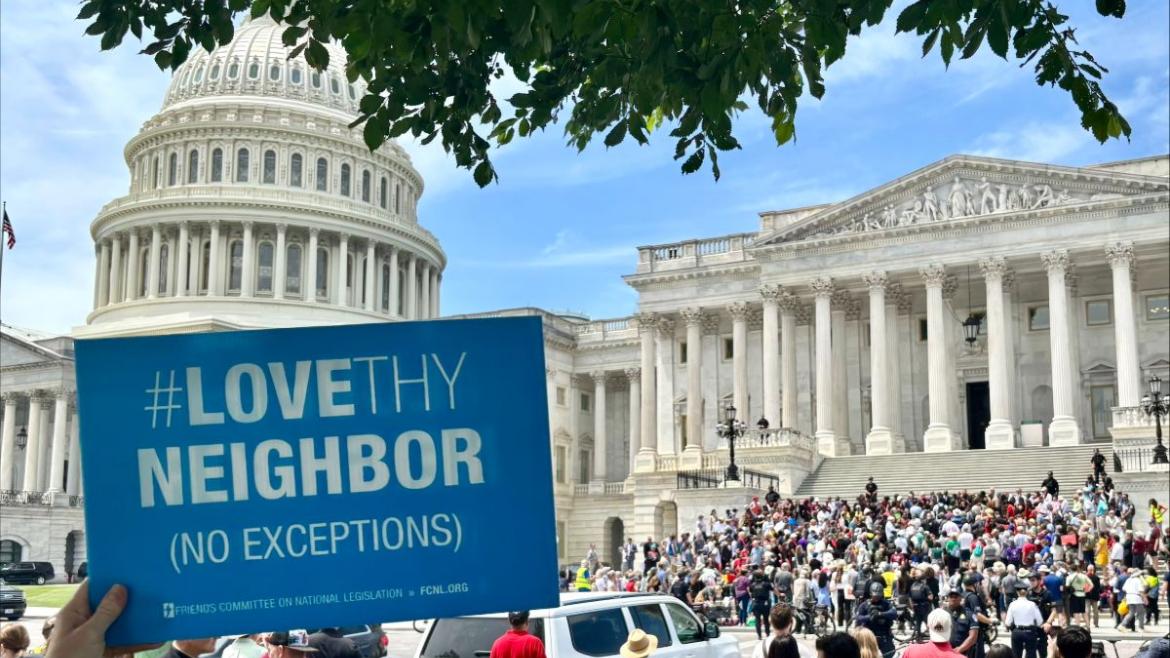
People power brought us to this step toward peace. As FCNL’s Hassan El-Tayyab puts it, “The grassroots peace movement deserves enormous recognition for this achievement — activists, organizers, and everyday people who and kept the pressure on for diplomacy when the path to war seemed inevitable. Their work helped force this moment and created space for diplomacy.”
Congress must formally reassert its constitutional authority over war and prevent future escalation in both Iran and Lebanon. FCNL continues to urge passage of Senator Tim Kaine’s (VA) S.J.Res.185 in the Senate and Representative Rashida Tlaib’s (MI-12) H.Con.Res.108 in the House. The House has already passed an Iran War Powers Resolution. It is past time for the Senate to pass one as well.
“This 60-day window is not an endpoint, it is an opening, and a narrow one. We must use it wisely, maintain pressure on all parties, and ensure Congress has the tools and the will to prevent the next crisis from dragging us back into regional war.”
This agreement remains very fragile. Notably, Israeli strikes in Dahiya, Lebanon, landed the very day this deal was being finalized, nearly causing Iran to walk away entirely. Ongoing escalation and humanitarian restrictions in Gaza, the West Bank, and Lebanon could unravel everything at any moment.
El-Tayyab frames it this way: “This 60-day window is not an endpoint, it is an opening, and a narrow one. We must use it wisely, maintain pressure on all parties, and ensure Congress has the tools and the will to prevent the next crisis from dragging us back into regional war.”
“The hard work of crafting a full peace deal is still ahead,” as Moix reminds us. “We know diplomacy with Iran and a nuclear deal is possible because they were achieved before. But the Trump administration needs to end its senseless war-first foreign policy and start upholding international law. True peace is only possible when we put human dignity first and invest in the hard work of real diplomacy.”