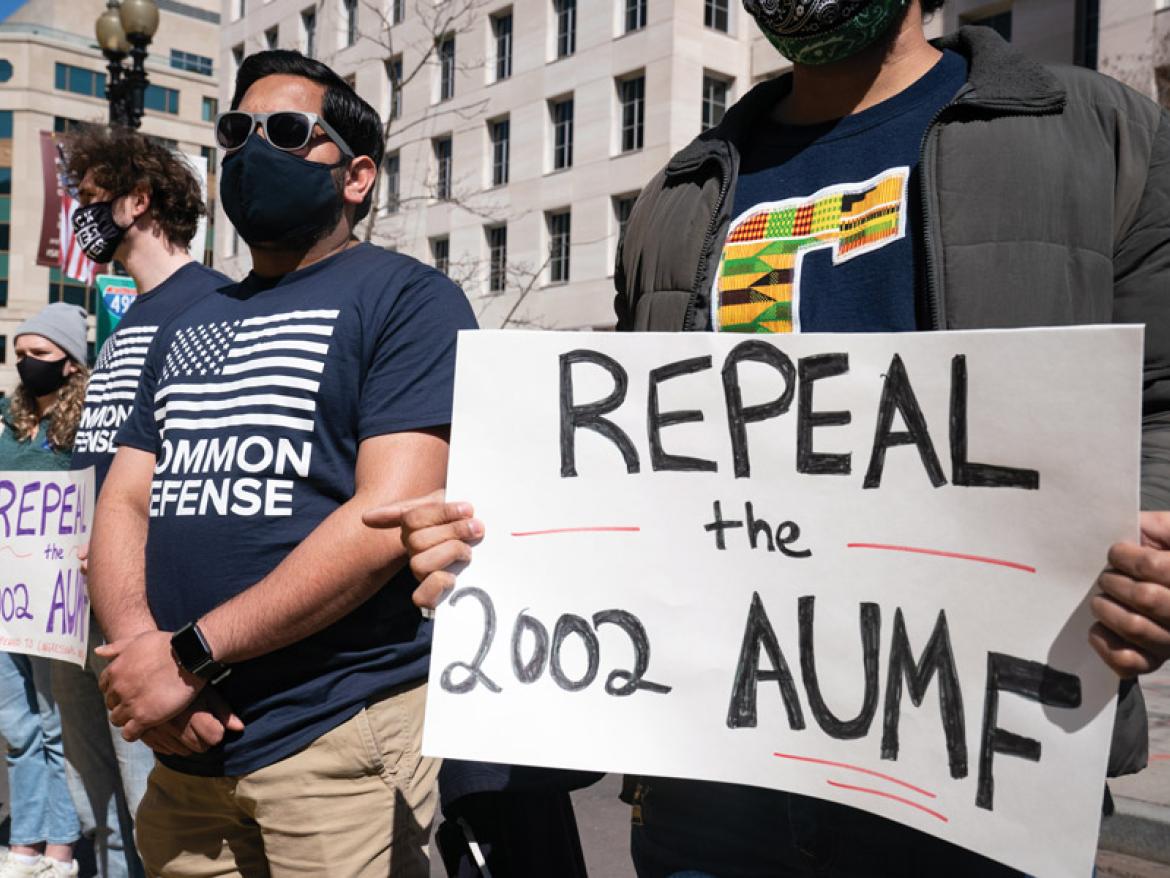
Victory came as a brief sentence: “Authorization for Use of Military Force against Iraq (Public Law 102-1; 105 Stat. 3; 50 U.S.C. 1541 noted) is hereby repealed.”
It was almost a throw-away section, buried in page 290 of the 3,086-page National Defense Authorization Act of fiscal year 2026 signed into law last December.
“It is a huge win to prevent further abuse,” said Heather Brandon-Smith, FCNL’s legislative director of foreign policy. “It is the first time in 55 years since the Gulf of Tonkin Resolution that Congress repealed a war powers authorization.”
Now the 2002 Iraq AUMF is completely off the table. The government can no longer use it to justify military interventions, like the 2020 strike in Iran that killed Gen. Qasem Soleimani.
Although this victory came as a brief sentence, behind it was a concerted effort by a coalition of peace activists, veterans, faith leaders, and thousands of grassroots advocates across the country.
“We decided to go for the low-hanging fruit first—the 2002 Iraq AUMF,” she said. “We wanted Congress to exercise their constitutional war powers muscle.”
When that coalition met in early January, they publicly acknowledged the leadership of FCNL and the Quakers in repealing the 2002 Iraq AUMF. FCNL had always been against the 2001 and 2002 AUMFs which were issued after the 9/11 attacks.
At first, the coalition lobbied against both the 2001 and 2002 AUMFs. When Brandon-Smith joined FCNL in 2018, the coalition changed its strategy. “We decided to go for the low-hanging fruit first—the 2002 Iraq AUMF,” she said. “We wanted Congress to exercise their constitutional war powers muscle.”
While the 2002 Iraq AUMF was also subject to abuse, it was limited in scope compared to the 2001 AUMF which was used to justify the Global War on Terror.
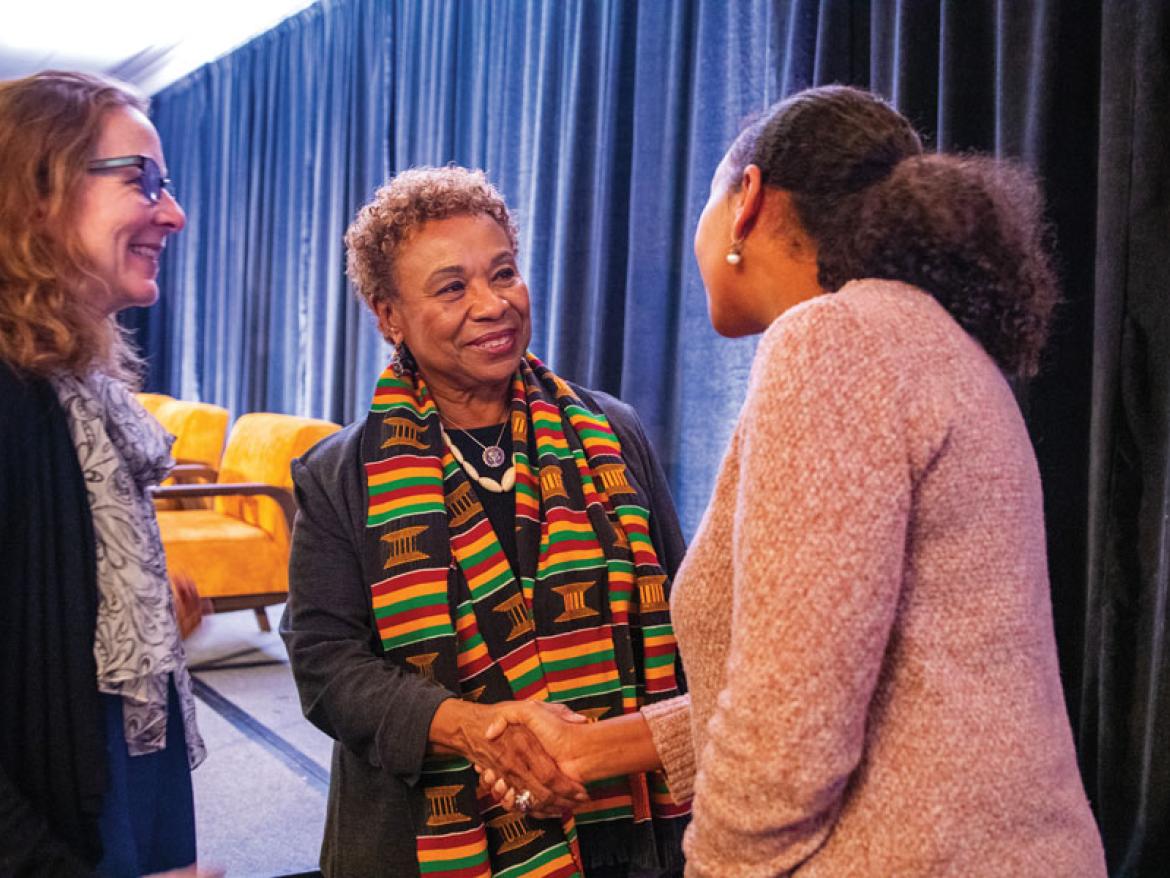
A key aspect of FCNL’s strategy was to get champions in Congress. In the House, former representative Barbara Lee was key because she was the congressional leader on AUMF repeal, having been the only member of Congress to vote against the 2001 AUMF. Rep. Chip Roy (TX-21) later joined her.
In the Senate, Sens. Tim Kaine (VA) and Todd Young (IN) were the champions. Sen. Young was a leader supporting the repeal of the 2002 Iraq AUMF when it was introduced as an amendment in the FY 2026 NDAA.
The chances for a repeal did not become clear until Dec. 9, 2025, when the White House issued the following statement: “Additionally, the NDAA is aligned with the President’s historic commitment to peace and ending ’forever wars’ by repealing the 1991 and 2002 Authorizations for Use of Military Force.”
Yet the coalition that has been working together on this repeal since 2015 did not ease up. Key coalition partners pressured the White House to support this repeal when it appeared that it would be used again as a bargaining chip for the FY 2026 NDAA.
“It was very exciting to announce to the Advocacy Teams that their years of advocacy had paid off and that the 2002 Iraq AUMF had officially been repealed,” said Tim Heishman, FCNL’s senior Advocacy Teams manager. “It is a win but repealing the AUMF is just one part of the larger need to curb U.S. military intervention and aggression around the world.”
While coalition partners and FCNL staff worked hard behind the scenes, it was Advocacy Teams, organized in 2015, that took on the challenging task of educating and organizing more activists. They conducted dozens of trainings throughout the country.
The teams wrote thousands of emails, made hundreds of phone calls and lobby visits to their members of Congress to press the issue. They amplified their voices by partnering with other faith leaders and wrote hundreds of letters in local media outlets.
“It was very exciting to announce to the Advocacy Teams that their years of advocacy had paid off and that the 2002 Iraq AUMF had officially been repealed,” said Tim Heishman, FCNL’s senior Advocacy Teams manager.
Sarah Stone, who used to manage the Advocacy Teams, remembers traveling with her predecessor, Shoshana Abrams. “We traveled with our little suitcases to Quaker meeting houses, training them to memorize talking points on connecting their stories with the issue.”
Stone remembers military veterans who broke down during the training. “They cried as they recalled the PTSD they or their relatives experienced and connected that to the need to end wars and U.S. militarism.”
The victory affirms FCNL’s advocacy model—ensuring that activists are trained well and are provided with the right information. “They become empowered and have the audacity to tell their members of Congress that they, as constituents, care about the issue,” said Stone.
Eventually, the issue resonated across the aisles in Congress. When it came to a floor vote in 2019, 19 Republicans voted to repeal. In 2020, 49 Republicans supported the repeal.
“It took 23 years to repeal the 2002 Iraq AUMF. I hope it will not take another 23 years to repeal the 2001 AUMF,” said Heishman. This AUMF is being used to justify military actions in Iraq, Syria, Somalia, Niger, and elsewhere.
It was ironic, however, that the victory came in a legislative package that increased the Pentagon’s budget to nearly $1 trillion—the largest ever budgeted for the military. Yet, by focusing on the low-hanging fruit, it affirms the practical and pragmatic approach of FCNL’s advocacy.
“This campaign is inspiring, and it has taught us lessons in tackling the 2001 AUMF and the growing militarism of the government—both within the country and abroad,” said Amelia Kegan, FCNL associate general secretary for policy and advocacy. “We are in this game for the long term as we work for a world without war.”