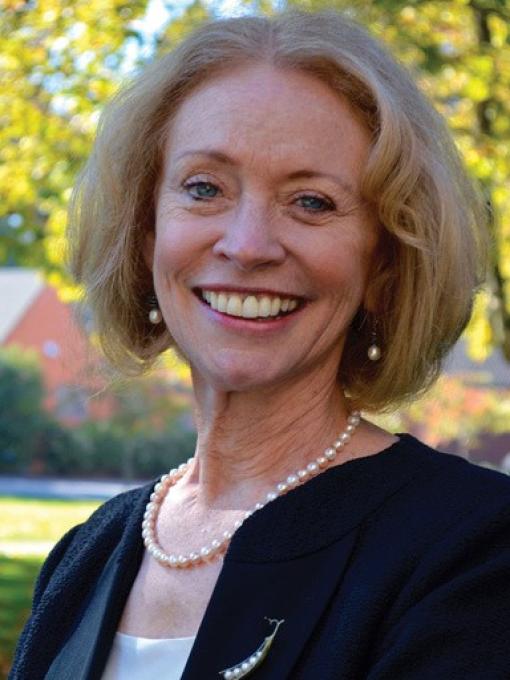
Long ago I walked into a cavernous hotel in downtown Washington DC on a November day. It was my first time at FCNL’s annual meeting. The entry space was surprisingly empty, but there was a woman sitting alone with a stack of papers in her lap. She looked up at me and said hello and smiled. I said that I was there for the Friends Committee on National Legislation annual meeting. She welcomed me warmly, introducing herself as Joanne Warner. She gave me a few pointers about registration. We shared about being glad to be here for FCNL. I then moved on, feeling much less like a shy person and more ready for the day ahead.
Later we gathered to begin the 2002 sessions. At the Clerk’s table, Joanne now welcomed us all with that same warmth. This year after 9/11 had been anything but easy for FCNL. Now the United States was pushing to go to war in Iraq. Major media outlets were publishing nothing by Quaker organizations who wanted to say why this push was a bad idea. The Authorization for Use of Military Force Against Iraq resolution of 2002 had just become effective on October 16.
Joanne did what clerks do. She invited us all to contribute from our experience, thoughts, and intuitions to find the way forward. There was space that day to acknowledge that the task was daunting, but the Clerk was clear that to dwell on doubt was not our task. Our job was to seek opportunities and to make the most of them. Through the entire weekend there was a sense of focused, creative space. We rely on Quaker clerks to bring out that spirit in everyone present, and Joanne did not disappoint.
These qualities shone through in the rest of Joanne’s life as well, as a mother, as the Dean of a School of Nursing, as a longtime cancer survivor, and more.
Joanne, who had first attended annual meeting in 1988, continued to advocate on FCNL’s concerns at home in Portland, Oregon with elected officials. She was also willing to advocate for FCNL itself, including in an interview for FCNL’s 75th anniversary video. In it, Joanne said:
“I was raising two sons…. I appreciated that FCNL gave me some concrete ways for them to see my faith. You can’t talk to kids … Well, you can talk to kids about abstract concepts but it is more powerful when they see how you live and when they see what you do. My sons watched me put my faith into actions through FCNL’s advocacy work. It was very powerful for them. It was a great peace for me to see that they knew that what motivated and empowered my advocacy was my faith, that I began with those values and things that I wanted to translate into the world.
The other amazing opportunity was that FCNL was the place that I could weave this tapestry of professional values, community health nursing, all the issues of social justice and peace. Quaker values, which we all know, which are very, very compatible with community health. Then my personal values, as a mom, as a woman in the world. I had such a strong, cohesive fabric of values that would give me strength and coherence and consistency in the actions that I would then bring into the world. I credit FCNL for helping me create the tapestry and weaving all of that together.”
Joanne was very often grateful to those around her. Yet Joanne truly brought her own gift for nurturing positive communities and relationships.
Just in the moment as the 2002 AUMF seems poised for repeal, an issue on which FCNL has consistently led, we can appreciate Joanne’s intrepid and abiding spirit with gratitude.