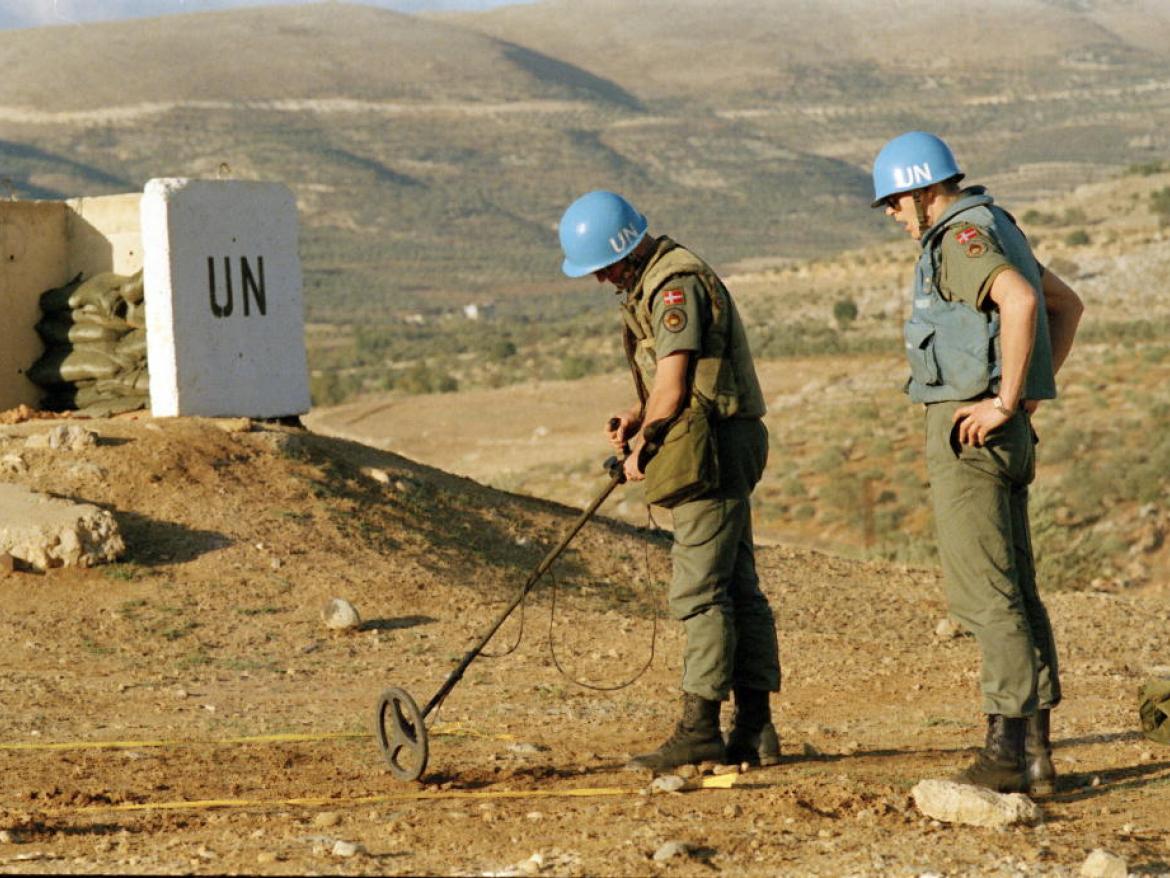
On December 19, 2025, the Trump administration lifted the United States’ prohibition on the use of antipersonnel landmines (APLs). Prior to this most recent change, U.S. policy had already begun to shift away from the global consensus prohibiting their use through specific exceptions and transfers.
Currently, the U.S. maintains a stockpile of approximately three million antipersonnel mines, and allows for the use, transfer and production of landmines under the new policy.. Here’s what you need to know about APLs and U.S. policy.
What are landmines? | What’s in the new policy? | What is the impact of landmines? | What are “smart” landmines? | Where are they deployed? | Who else uses them? | What is the Mine Ban Treaty?
What are landmines?
Landmines, also known as anti-personnel mines, are defined as mines “designed to be exploded by the presence, proximity or contact of a person and that will incapacitate, injure or kill one or more persons.”
They cannot distinguish between civilian or combatant. Landmines do not follow ceasefires or peace processes – they lie dormant for decades and continue to inflict suffering on civilians long after a conflict ends.
What’s the current landmine policy in the U.S.?
The U.S. currently has no ban on antipersonnel landmine use. In December 2025, the Trump Administration issued a Pentagon memo formally lifting the general prohibition that previously restricted U.S. forces from using antipersonnel mines. This returned U.S. policy to an earlier rollback by the previous Trump administration back in 2020.
This reversal followed a series of incremental shifts. In 2022, President Biden announced a near global ban on the use, production, transfer, and stockpiling of APLs, with one exception: the Korean Peninsula, effectively reinstating the Obama administration’s 2014 policy. The Biden administration undercut its own policy in late 2024, transferring APLs to Ukraine and breaking a U.S. export moratorium that had been in place since 1992.
What is the impact of landmines?
Landmines are indiscriminate weapons that disproportionately impact civilians, and especially children. From 1999 through 2024, there have been 165,724 reported casualties as a result of landmines, though the true number is likely much higher as accurate data is difficult to gather. Last year had the highest number of casualties since 2020.
According to the Landmine Monitor, in 2024 alone:
- Landmines caused at least 6,279 casualties, around a third of which were deaths.
- Civilians accounted for 90% of landmine casualties.
- Children accounted for at least 41% of all casualties.
What are “smart” landmines?
Claims by the U.S. military that some landmines are “smart” or “non-persistent” are false. Efforts to create “smart mines” through self-destruct and self-deactivation mechanisms have failed to function as advertised. The Government Accountability Office found that “smart mines” deployed in the Gulf War failed at a rate 150x higher than the Department of Defense had reported. Additionally, while so-called “non-persistent” landmines contain mechanisms that shorten the lifespan of the trigger, the explosive materials remain—and with it their lethality, indiscriminate nature, and ability to harm civilians.
These mines are rarely hand-planted, carefully mapped, and marked. Instead, they are often scattered by aircraft and artillery over unmarked terrain, creating further danger for civilians and aid workers who have no way of knowing whether they are in or entering a minefield.
The self-destruct timers Russia deployed landmines have created terror among civilians during its ongoing invasion of Ukraine. According to one survivor, whose farm was hit with scatterable landmines, “the bursts continued throughout the day with intervals around 50 minutes, and the last one was around 3 o’clock the next night after it first landed […] It was lucky that kids didn’t play there that day, normally they would play in the backyard at the time of the first pieces detonating, but it was rainy that day.”
Where are they deployed?
As of November 2025, landmines have contaminated at least 57 countries, with hundreds of thousands of civilians living under threat. These include countries like Cambodia, Laos and Vietnam, which collectively have hundreds of thousands of acres of land contaminated by American-dropped unexploded ordnance.
Ukraine currently has some of the worst landmine contamination in the world. Two world wars and the ongoing Russian invasion have left more than half the country covered with landmines and unexploded ordinance. They have the most widespread use of antipersonnel mines seen in decades. As of April 2025, about 105,877 km² across nine regions is contaminated with landmines and leftover explosives from war. While efforts to clear the land are underway, with fighting still ongoing, it is especially complicated. In 2024, Ukraine checked only 28.37 km² of contaminated land.
The human cost of this crisis is grave. The Landmine Monitor recorded 293 injuries and deaths in Ukraine related to landmines in 2024 alone, with a rise in non-lethal amputations as well.
The United States currently has no active minefield under its control. The minefields the U.S. once implanted on the Korean Peninsula are now the responsibility of South Korean forces. The last large scale confirmed use by the United States was in 1991 in Iraq and Kuwait, when U.S. forces deployed 117,634 antipersonnel mines. However, it is reported that U.S. forces in Afghanistan deployed Claymore directional fragmentation mines in 2009 and 2010.
In an important recent development, the U.S. appears to have started using anti-tank mines again for the first time in over thirty years. In March 2026, weapons experts reported that the U.S. dropped scatterable anti-tank landmines over a village near Shiraz, Iran. This is the first major U.S. use of anti-tank mines since the 1991 Gulf War. Although these mines are not banned by the 1997 Mine Ban Treaty as they are designed to explode when large vehicles pass nearby, they have self-destruct features that can make them go off hours or days after being dropped, creating a lasting threat to local civilians.
Who uses them?
As of 2025, there are 12 countries that develop, produce and acquire antipersonnel mines. Following the Trump Administration’s policy shift, the United States is once again a part of that list, which includes Armenia, China, Cuba, Iran, North Korea, Pakistan, Singapore, and Vietnam. Of those 12, four are actively producing or developing landmines, including India, Myanmar, Russia and South Korea.
Between 2024 and October 2025, governments including Russia, Myanmar, Iran, North Korea, Ukraine and Cambodia have used APLs according to the Landmine Monitor. In at least 13 countries, Non-State Armed Groups used APLs over that same period.
Additionally,2025 saw an increase in withdrawals from the Mine Ban Treaty. Estonia, Finland, Latvia, Lithuania and Poland have all formally initiated the procedure to withdraw. Finland, Lithuania, and Poland have all indicated they will begin producing antipersonnel mines. Estonia, Latvia, and Lithuania have expressed their intent to acquire new stockpiles. Poland has expressed a potential need for one million landmines to secure its borders with Belarus and Russia.
What is the Mine Ban Treaty?
The Convention on the Prohibition of the Use, Stockpiling, Production and Transfer of Anti-Personnel Mines and on Their Destruction, also referred to as the Ottawa Convention or the Mine Ban Treaty, was adopted in 1997.
The 164 countries that are party to the Mine Ban Treaty as of February 2020, representing over 80% of the world’s states, are required to:
- Not develop, produce, acquire, use, retain, stockpile, or transfer anti-personnel landmines, or assist or encourage others in such actions.
- Destroy all current stockpiles of anti-personnel landmines.
- Identify and clear all mined areas under their jurisdiction or control within 10 years.
- Assist other states in clearing and destroying mines if able, and provide assistance to landmine victims.
- Report annually to the U.N. any landmines under their control, and the status of efforts to destroy them.
The Mine Ban Treaty, aided by the International Campaign to Ban Landmines and Cluster Munitions, has made a massive contribution towards global peace and security through the destruction of over 53 million antipersonnel mines.
However, so long as 32 nations—including the United States, Russia, China, India and Pakistan—are not party to the Mine Ban Treaty, the world continues to live under threat.
What more needs to be done?
The goal of acceding to the Ottawa Convention has been significantly set back by the Trump administration’s December 2025 decision to lift the general prohibition on the use of APLs as well as the Biden administration’s 2024 decision to transfer APL’s to Ukraine.
FCNL urges the White House to not only reinstate a total ban but to permanently end the Korean Exception and put the U.S. fully in line with the 166 countries already party to the Mine Ban Treaty. Congress must take immediate legislative action to block the deployment of landmines and prohibit the development, production, and acquisition of new mines. By joining and aligning its policy with the Mine Ban Treaty, the U.S. can play a critical diplomatic role in pushing back against the erosion of treaty.