In the years since the September 11 attacks and throughout the so-called “Global War on Terror,” drones rapidly became one of the U.S. military’s primary weapons as U.S. counterterrorism policy gravitated toward methods that are more secretive, more lethal, and more removed from the battlefield. Here’s what you need to know.
What are drones? | Cost | Targets | Congress | Administration | Implications
What are drones?
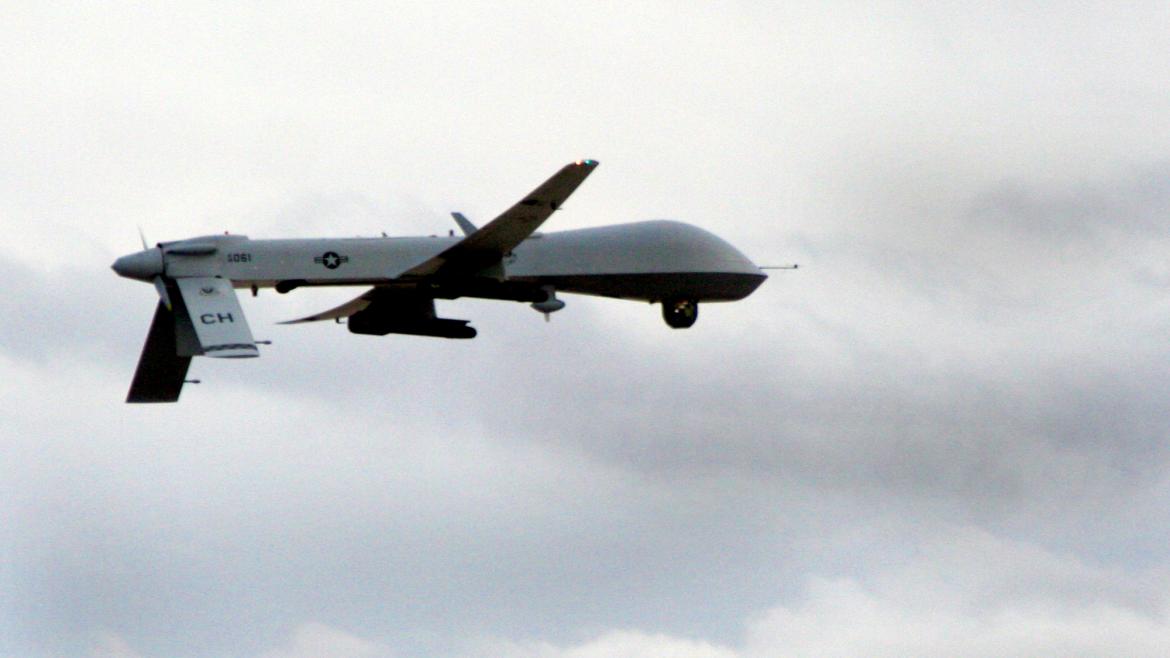
Unmanned aerial vehicles, commonly known as “drones,” are remotely controlled aerial systems that are used to carry out lethal counterterrorism strikes as well as surveillance and other non-lethal operations. FCNL focuses primarily on the problem of lethal drone strikes and U.S. lethal drone policy.
How does the United States use drones?
Throughout the post-9/11 wars, both the U.S. military and the CIA have used drones as part of the so-called “Global War on Terror.” Both agencies have employed drones during conventional fighting in recognized battlefields as well as to conduct the targeted killing of individuals alleged to be members of certain non-state groups outside of war zones. The latter strikes have been highly criticized as violating both the Constitution and international law.
The CIA’s drone program still remains largely secret. The Obama administration took steps to transfer all authority for the U.S. drone program to the Department of Defense (DOD) in order to increase transparency and accountability for the program. However, the first Trump administration reversed course and expanded CIA drone use. The Biden administration conducted a review of U.S. drone policy in 2021, however, it did not make any effort to transfer the CIA’s drone program to the DOD.
The United States has conducted drone strikes in Afghanistan, Iran, Iraq, Libya, Nigeria, Pakistan, Somalia, Syria, and Yemen, and to target boats carrying alleged narcotics traffickers in international waters. The latter strikes have been heavily criticized by legal experts as violating both domestic and international law and exposing U.S. service members to risk of prosecution for carrying out patently illegal orders.
How much do drones cost the United States?
The cost per flight hour varies by type of drone, but the larger armed systems such as the Global Hawk cost up to $18,591 per hour.
The total costs of the U.S. drone program are difficult to assess. Both the Department of Defense and CIA budgets for lethal drones are subject to classification and funding is spread across many different legislative line items, so is often not clearly marked. This lack of transparency and the failure to conduct a cost-benefit analysis of the program has been criticized by experts. For fiscal year 2027, the Pentagon requested $55 billion for drones and other autonomous weapons systems. This is a significant increase from the approximately $225 million requested for fiscal year 2026.
Who do the drones target?
In the post-9/11 wars, the United States has used drones to target members of non-state organized armed groups on the battlefield, including ISIS in Iraq and Syria, al Qaeda and the Taliban in Afghanistan, and al-Shabab in Somalia.
In addition, the U.S. government uses drones to target people on a “kill list” who the administration considers to be “high-value” targets and who may or may not be in an active war zone. Drones are also used to conduct “signature strikes” based on vaguely defined, suspicious patterns of an individual’s behavior. This has often resulted in the mistaken targeting of innocent civilians. For example, a January 2018 strike in Yemen misidentified and killed a 70-year-old farmer and his younger relative and an August 2021 strike in Afghanistan mistakenly targeted an innocent man and his nine family members, including seven children.
Since September 2025, the United States has also used drones to target alleged narcotics traffickers in the Caribbean Sea and the Pacific Ocean. The U.S. government claims it is targeting members of so-called “Designated Terror Organizations” on a secret list, who are in an armed conflict with the United States. This claim has been criticized by legal experts who have noted that the “fundamental problem is simply that the United States is not engaged in an armed conflict with any drug cartel.”
What is Congress’ role in the U.S. drones program?
Three days after the September 11 attacks, Congress passed the 2001 Authorization for Use of Military Force (AUMF), which authorized military action against those responsible for the 9/11 attacks and those who harbored them. Since then, successive presidents from both sides of the aisle have interpreted the AUMF to justify drone strikes around the world. While many members of Congress have said that the executive branch’s interpretation of the AUMF far exceeds congressional intent, Congress has never acted to rein in the AUMF or to limit the use of drones.
Congress facilitates the U.S. drone program by appropriating funds for the research, development and procurement of drones. Congress also exercises oversight of the U.S. drone program, though much of this is carried out in classified briefings with the House and Senate intelligence committees. In 2017, Congress increased the public reporting requirements for some drone strikes and other lethal operations, requiring the Pentagon to report on how many civilians and combatants were killed and injured in U.S. military strikes, including by drones. These requirements were strengthened in the annual defense spending bill for fiscal year 2019. CIA strikes are not included, and the reporting requirements expired in 2022.
What is the administration’s role in the U.S. drone program?
Due to increasing alarm at the number of people killed by drones outside of war zones during the Obama administration, the executive branch implemented a policy tightening the rules for when it could conduct strikes outside “areas of active hostilities.” This policy included the requirements that only high-level members of non-state groups could be targeted, and that there was near certainty that both the target was present and no civilians would be harmed. The Trump administration loosened these rules, allowing for lower-level fighters to be targeted and giving more control to commanders to make targeting decisions. The Biden administration tightened the rules again, bringing them more in line with that of the Obama administration.
President Biden also initiated an interagency review of U.S. counterterrorism operations, including drone strikes and special-operation raids. Biden also issued classified interim guidance on the use of military force and related national security operations, reportedly granting himself full visibility of proposed significant operations. Under the temporary guidelines, the Central Intelligence Agency (CIA) lost its authority to conduct kill-or-capture missions without White House approval, previously delegated by the first Trump administration.
But the Biden administration also repeatedly pledged to conduct “over-the-horizon” remote strikes outside of war zones, even after withdrawing from Afghanistan. The second Trump administration has doubled down even further on its reliance on lethal drones abroad. In 2025, the Pentagon established a “Drone Dominance Initiative,” inviting weapons manufactures to compete for $1.1 billion in contracts to produce lethal drones. The department announced the five winners of its “Lethality Prize Challenge” in March 2026.
What are the long-term implications of the use of drones?
With no overarching strategy and minimal congressional oversight and public transparency, many mistakenly see drones as a low cost—human and financial—alternative to traditional war. But this is far from the case. The drone program helps keep the United States in a constant state of endless war, where leaders are quick to choose lethal military options in response to complex foreign policy challenges over effective non-violent solutions. This harmful and destabilizing path has resulted in the deaths of over 929,000 people, including more than 363,939 civilians, at a cost of at least $8 trillion.
Drones and “Blowback”
Evidence suggests that the trauma of living under drones fuels anti-American sentiment and aids in recruitment to armed groups that engage in terrorism. Indeed, both the al Qaeda network and ISIS have leveraged the collateral damage from U.S. strikes as a propaganda tool to bolster recruitment efforts. This impact is known as “blowback”– the long-term unintended consequence of actions taken today.
Effects on Drone Pilots
This form of war has also had unprecedented effects back home. A Defense Department study found that drone pilots experience mental health problems at the same rate as pilots participating in live combat. Despite working thousands of miles away from the physical impact of the strikes, many drone pilots experience worrying levels of anxiety, depression, severe stress, and moral injury. Moreover, the military has had a difficult time retaining drone pilots. Long hours—often between three to six times the maximum annual flight hours of regular Air Force pilots—play a major role.
A Dangerous Precedent
The U.S. drone program is setting a troubling precedent for how such operations are conducted by others. The lack of oversight, transparency, and accountability of the U.S. program may serve as a harmful model for other countries. More than three dozen other countries have acquired armed drones, many of which are developing their own drone programs. Non-state groups, including ISIS and the Houthis, have also acquired armed drones.
The Future of Drones and Warfare
Currently, hundreds of companies are developing small and large-scale drone technology, and both state and non-state actors are seeking to integrate drone technology into their military programs. Experts suggest that drone capabilities will rise dramatically in the coming years.
It is past time to pause and evaluate the outcomes of U.S. drone policy. Congress should fully investigate the long-term impacts of drone warfare. We as a country must ask ourselves some serious questions. Aside from the moral issues raised by drone use, there are real questions about their impact on the future of U.S. national security. What has been the impact of drones on U.S. national security and human rights? Has the drone program actually been effective at countering terrorism and keeping the homeland safe? What happens when the United States no longer dominates over this technology? What can be done to prevent non-state armed groups from acquiring drones?
The United States, together with the international community, must recognize these challenges and begin to outline restrictions and accountability for drone use. Restraining the use of drones worldwide is undoubtedly in the best interest of a more just and peaceful world.