Prepared for the U.S. House Committee on Appropriations’ Subcommittee on National Security, Department of State, and Related Programs
By Bridget Moix, General Secretary, Friends Committee on National Legislation (FCNL)
Chairman Diaz-Balart, Ranking Member Frankel, and Members of the Committee, thank you for the opportunity to testify. Founded in 1943 by members of the Religious Society of Friends (Quakers), the Friends Committee on National Legislation is a national, nonpartisan Quaker organization that advocates for a world free of war and the threat of war, a society with equity and justice for all, a community where every individual’s potential may be fulfilled, and an earth restored. A full list of FCNL’s FY27 NSRP priorities has been included in the chart at the end of my testimony.
I come before you today at a moment of profound upheaval in our country and world. The United States stands at a crossroads. In one direction, the current path of this administration lies the continued disregard and dismantling of vital international norms and institutions for peace and development. That path leads to U.S. isolation and diminished standing in the world, the loss of more innocent lives, a quagmire of endless war, economic turmoil, and irreversible planetary crisis.
In the other direction lies a still challenging but more promising opportunity – one that reflects our country’s deepest shared values and reasserts the Constitutional authorities of Congress. That path involves renewing U.S. leadership, improving international cooperation and preventing war, investing in peace and development, and crafting better solutions for the problems our world is facing. The choices this Congress makes in the FY2027 National Security, Department of State, and Related Programs (NSRP) bill will help determine which of these paths is chosen.
Before sharing our recommendations for this legislation, I want to express my gratitude for your hard-fought bipartisan work on the FY26 NSRP bill and for the steps this Congress has taken to restore funding to a number of critical development, humanitarian, and peacebuilding programs. That work matters and is saving lives. Thank you.
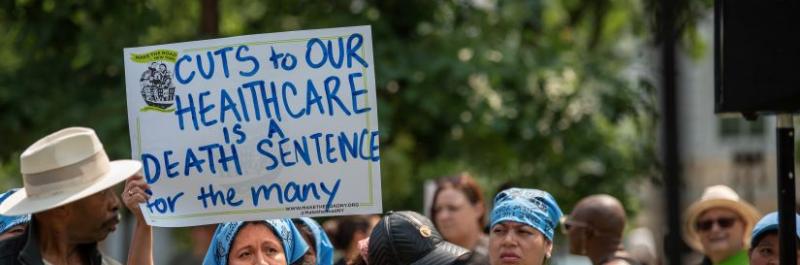
Unfortunately, the dismantling of USAID, U.S. foreign assistance, and key State Department functions over the past year is too widespread for individual program restorations to be enough. The White House’s sweeping cuts are already exacting a real toll: lives lost, U.S. leadership undermined, and goodwill eroded abroad. Far from saving money or improving efficiency, this dismantling is making America and the world less safe, less prosperous, and less prepared for the crises ahead.
We need a serious rebuilding of both our diplomatic capacities and our foreign assistance architecture to manage the multiple crises wracking our world and affecting our own communities here at home. We need to begin that work now and we need Congress to ensure that all funds appropriated by law are expended in full for the purposes intended. Violence, climate shocks, and forced displacement are among the defining challenges of our time, and they cannot be solved by military escapades or by cutting spending, closing programs, or dismantling the agencies built to address them.
We urge you to continue working across the aisle to legislate on behalf of the American people, to resist executive overreach and reassert the congressional power of the purse, and to listen to both your constituents and your conscience. The future of our democratic experiment, and perhaps our world, is depending on you.
In fiscal year 2027, FCNL urges Congress to shift federal spending away from militarism and toward investments that reduce human suffering and build lasting security—cutting excessive military funding while increasing support for peacebuilding, humanitarian aid, displacement assistance, and climate resilience. Commitment to human dignity, diplomacy, and international cooperation has long drawn bipartisan support and can again. The question before Congress is not whether to restore the old system, but whether we seize this moment to build something better.
The urgency of reordering federal priorities becomes evident upon examining how funding has been allocated in recent years and the President’s new budget proposal. In FY2026, the Department of Defense received $838.7 billion, which is more than 16 times the $50 billion given to the State Department. In fact, the State Department’s entire budget is nearly equivalent to what the U.S. Air Force receives just to spend on weapons and munitions. In FY2027, the President is requesting [$1.5] trillion for war and weapons, alongside $35.6 billion for the State Department and other international programs.
Congress should soundly reject the White House’s grossly imbalanced spending proposal and invest in a more effective, more humane, and less costly approach to advancing peace, justice, and prosperity for all. The programs outlined below are proven, cost-effective approaches that Congress has supported for years and deserve your continued investment.
Foreign assistance programs provide food, medical aid, and shelter to millions at their most vulnerable. After one year, experts estimated that there were over 270,000 adult and over 550,000 child preventable deaths from the termination of funding for former USAID programs, including those for preventing and treating tuberculosis and PEPFAR. As of January 2026, new research has found that countries that previously received significant foreign assistance investments have seen around a 5% increase in the number of conflict events since the dissolution of USAID.[i]
The decimation and politicization of the U.S. Refugee Admissions Program (USRAP), once a bipartisan cornerstone of lifesaving protection, is also profoundly destabilizing. Reducing the FY2026 presidential determination to just 7,500 abandons vulnerable families fleeing violence and persecution while undermining U.S. credibility amid escalating global conflicts. Equally troubling is the administration’s selective approach to protection — elevating certain groups like Afrikaners while sidelining others in acute danger — eroding the fairness that must define U.S. refugee policy.
Congress has a critical role to play in restoring balance, strengthening oversight, and establishing guardrails so that our humanitarian commitments are guided not by politics, but by longstanding American values. Accordingly, we urge, not less than $8.7 billion for the International Humanitarian Assistance and $100 million for the Emergency Refugee and Migration Assistance accounts. This must include a full and fair restoration of USRAP.
Around the world, violent conflicts cause great harm to civilians, including through the use of indiscriminate weapons like banned cluster munitions, starvation and sexual violence as weapons of war, and targeted attacks against ethnic, racial, and religious groups. Peacebuilding and conflict prevention programs help reduce violence, address the causes of conflict, and build the long-term stability that prevents costly crises down the road. The return on investment is striking. According to the International Monetary Fund, every dollar spent preventing violent conflict saves between $26 and $103 in conflict-related costs.[ii]
Unfortunately, already limited funding available for violence prevention and peacebuilding has been cut. The Complex Crises Fund, one of the only flexible funding mechanisms available to respond to escalating conflicts in real time, has been politically targeted and dismantled, despite a proven track record of supporting locally-led violence intervention in places like Mali, Mozambique, Libya and South Sudan.
The consequences of these cuts are already visible. In February 2026, the UN Independent Fact-Finding Mission on Sudan reported that the RSF’s takeover of El Fasher showed clear signs of genocide. That this is unfolding amid the dismantling of U.S. conflict prevention tools is not a coincidence. The Elie Wiesel Genocide and Atrocities Prevention Act — signed by President Trump during his first term and co-sponsored by then-Senator Rubio — establishes mass atrocities prevention as a national security priority. Congress now has both the legal mandate and the urgent reason to act.
Atrocities Prevention funding is the primary tool for putting that law into action and the State Department’s only funding dedicated solely to preventing mass atrocities and genocide. We urge the restoration of Atrocities Prevention in the bill text rather than report language, and funding of no less than $25 million for Atrocities Prevention. In tandem, we urge allocating the State Department no less than $1 million to conduct Atrocities Prevention Training as mandated by the Elie Wiesel Genocide and Atrocities Prevention Act (P.L. 115-441), signed into law by President Trump in 2019.
One of the most effective ways to prevent future violence is addressing past instances of it. Reconciliation Programs support people-to-people peacebuilding efforts that advance mutual understanding and conflict transformation between different ethnic, racial, religious, or political groups in conflict areas. For over two decades, these programs have helped societies recovering from conflict engage in nonviolent resolution, reconcile differences, and work toward common goals. We urge the inclusion of Reconciliation Programs in the bill text and report language, and funding of no less than $25 million for Reconciliation Programs.
Because FCNL actively lobbied for the creation of the United States Institute of Peace (USIP) at its inception and supported its funding since, we feel compelled to also raise our deep concern for the way the administration has upended the institution and violated its congressional mandate. We urge this committee to exercise its oversight authority and ensure the White House respects USIP’s legally established purpose and structure. We also urge $54 million in funding and close oversight for how such funding is utilized in accordance with the institutions congressionally mandated mission of helping prevent and resolve violent conflicts abroad, which pose risks for U.S. and global security.
Among the most effective resilience-building investments is the Adaptation program, which helps developing nations withstand the extreme weather events that climate change makes more frequent: floods, droughts, intense heat, and rising seas. The consequences are severe: deepening hunger, heightened conflict, displacement, and poverty. These impacts fall hardest on countries that have contributed the least to the problem. On the ground, this looks like weather monitoring infrastructure, early warning systems, and drought-resistant crop programs in the Horn of Africa. It is also fiscally smart: every dollar invested in climate resilience returns three dollars in avoided humanitarian costs.[iii]
Therefore, we urge not less than $270 million for Adaptation, not less than $260 million for Renewable Energy, which supports energy projects aimed at reducing greenhouse gas pollution in developing countries, and no less than $176 million for Sustainable Landscapes, which sustainably manages, protects, and restores forests and other natural landscapes.
In sum, we urge Congress to heed a prophetic call: not just to restore what was lost, but to rebuild something better. To ensure foreign assistance funds are spent as intended, Congress must immediately put meaningful guardrails in place. The dismantling of USAID has exposed critical gaps in oversight, allowing funds to be redirected, delayed or cut without congressional approval. Restoring accountability requires action on several fronts: prohibiting unauthorized transfers of funds, away from congressionally designated purposes; mandating Office of Management and Budget (OMB) apportionment within 60 days of enactment; requiring 15-day notice before programs are substantially altered, suspended, or terminated; and restoring quarterly public reporting to ForeignAssistance.gov on obligations, disbursements, and outcomes.
We urge Congress to use its constitutional power of the purse to redirect U.S. foreign policy away from its current destructive path toward a future defined by justice, human dignity, care for our earth, and lasting peace for all.
Chairman Diaz-Balart, Ranking Member Frankel, and Members of the Committee, I thank you for the opportunity to testify.
Account Name | FY26 Enacted | FY27 Request |
Atrocities Prevention | $6,000,000 | $25,000,000 |
Atrocities Prevention Training, State Department | $500,000 | $1,000,000 |
Reconciliation Programs | $0 | $25,000,000 |
Emergency Refugee and Migration Assistance | $100,000,000 | $100,000,000 |
International Humanitarian Assistance Account | $5,400,000,000 | $8,707,000,000 |
Renewable Energy | $0 | $247,000,000 |
Sustainable Landscapes* | $131,813,000 | $176,000,000 |
Adaptation | $0 | $270,000,000 |
UN Relief and Works Agency for Palestine Refugees | $0 | $400,000,000 |
Middle East Partnership for Peace Programs | $37,500,000 | $100,000,000 |
East Jerusalem Hospital Network | $0 | $120,000,000 |
International Organizations and Programs | $339,000,000 | $436,900,000 |
United States Institute of Peace | $20,000,000 | $54,000,000 |
*Referred to as Land Use, Management, and Protection Program