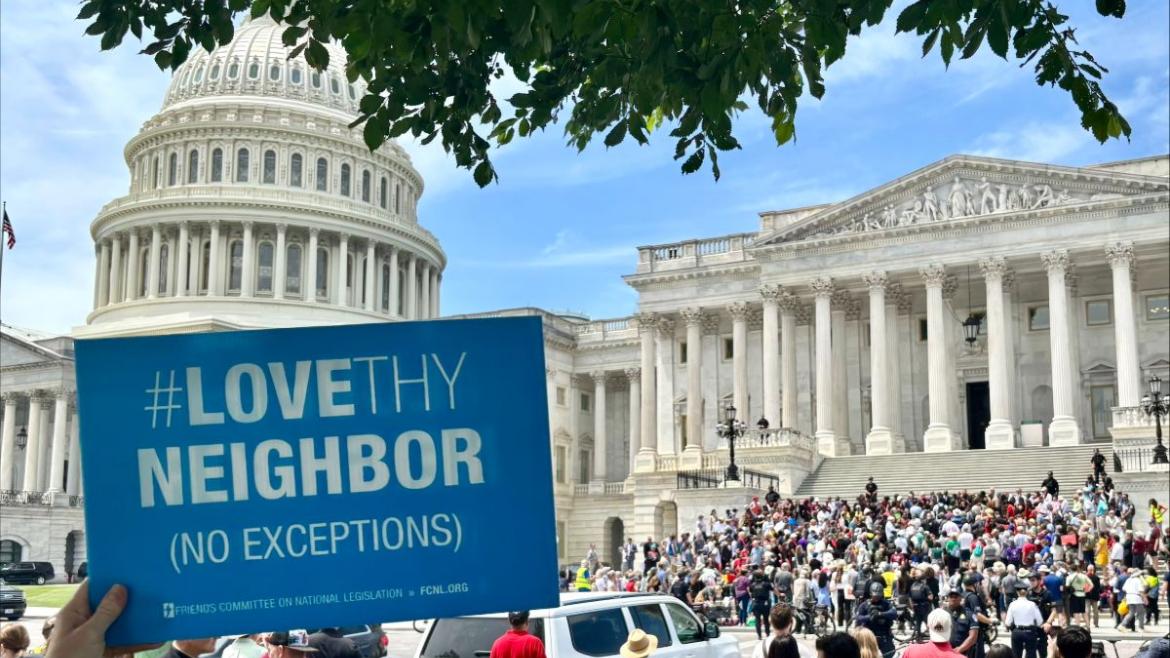
The Senate will soon vote on a War Powers Resolution, as early as today, October 8, to stop the Trump administration’s unlawful strikes against boats suspected of trafficking drugs in the Caribbean.
If passed, the resolution, introduced by Sens. Adam Schiff (CA) and Tim Kaine (VA), and co-sponsored by Sen. Rand Paul (KY) and Sen. Bernie Sanders (VT), would terminate hostilities against drug cartels that the administration has designated as “foreign terrorist organizations” as well as any states those organizations operate in.
The senators are boldly pushing back on President Trump’s rapid escalation of military activity in the Caribbean and near the sovereign state of Venezuela. The administration has now carried out at least four strikes on vessels in international waters, killing more than 20 people.
An Alarming Claim of “Armed Conflict” Against Drug Cartels
On October 2, the President told Congress he has “determined” that the United States is now engaged in “armed conflict” with drug cartels and promised to continue these strikes on land.
These events are alarming, and such claims are terrifying and unacceptable. The strikes in the Caribbean are illegal, blatant overreach of presidential powers, and immoral violations of the basic rights to life and due process. The assertion that the United States is in an “armed conflict”—the technical term for war—with drug cartels means that the President is claiming the power to use lethal force as a first resort against suspected members of these cartels.
President Trump is clearly trying to expand his powers to use lethal force. By setting a new precedent for the extrajudicial killing of suspected drug traffickers, there is little distance from killing on the high seas to the president using lethal force in other countries’ territory or even domestically.
Why The Caribbean Strikes Are Unlawful
These strikes were taken entirely in the absence of any authority under either U.S. domestic law or international law.
The U.S. is not at war with Latin American drug traffickers. Only Congress has the constitutional power to authorize the use of military force or declare war. The designation of certain groups as “Foreign Terrorist Organizations” does not provide any authority for the use of lethal military force against them. There are FTO-designated groups around the world, including in Ireland, Indonesia, and Sri Lanka. Just as the U.S. should not launch a missile strike in Belfast to attack members of the New IRA, it should not use lethal military force against any FTO-designated Latin American drug cartel.
These killings were extrajudicial, without due process. Indeed, they were assassinations or murder, which are categorically prohibited in the U.S. code (see here, here, and here).
Congress is Stepping Up
Thankfully, several members of Congress are taking action. In addition to the Schiff/Kaine War Powers Resolution, Reps. Ilhan Omar (MN-05) and Jason Crow (CO-06) have also introduced resolutions under the 1973 War Powers Act to end these unlawful attacks. Members of both parties in Congress are raising the alarm as well, including Senate Armed Services Committee Ranking Member Jack Reed (RI), House Foreign Committee Ranking Member Gregory Meeks (NY-05), and Sen. Rand Paul (KY) who is co-sponsoring the Schiff/Kaine Resolution.
FCNL mourns each life taken. We are not new to grieving murder and other harms carried out by excessive U.S. militarism (e.g. police brutality, torturous detentions, genocide). We refuse to be desensitized. We further grieve how our friends, neighbors, and families impacted by drug use are abandoned by the violent and ineffective “war on drugs” strategy. We must continue to seek public health solutions and dignity for them.
Out of care for human life, Congress should vocally and categorically denounce these strikes, emphasize that we are not in an “armed conflict” with drug traffickers, and move to stop any further acts of violence in the Caribbean. War is not the answer at home or abroad.