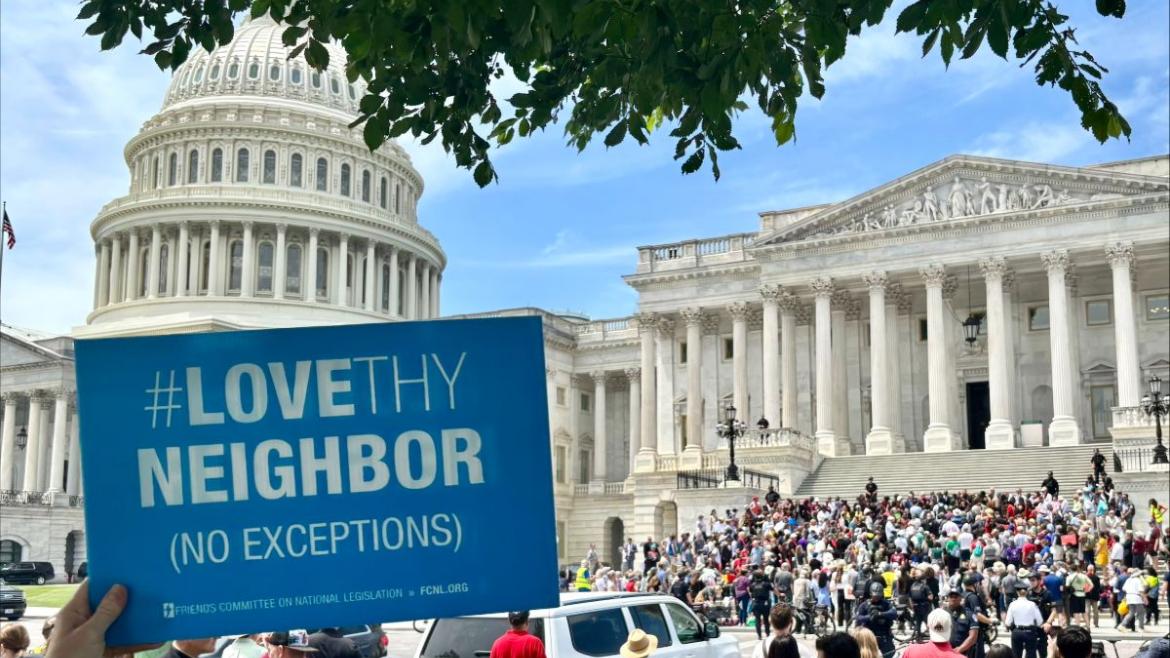
In late July, the House Appropriations Committee passed spending legislation that if enacted, would cut over $13 billion in funding from foreign aid and diplomacy, a 22% cut from current levels, and reduce guardrails against politicization.
This bill — the Fiscal Year 2026 National Security, Department of State, and Related Programs (NSRP) Appropriations Act — was passed by the committee along party lines.
Previously named the State, Foreign Operations, and Related Programs Appropriations Act, the NSRP bill is an annual appropriations bill that sets funding levels for a wide range of programs related to U.S. foreign policy.
While avoiding some of the most severe cuts proposed by President Trump, the bill would nonetheless fundamentally reshape how the United States engages in the world.
Slush Funds and Cuts
In his budget request to Congress, President Trump proposed eliminating several core economic assistance accounts and creating a new slush fund for the president with significantly fewer regulations.
The House NSRP bill sought a middle ground by combining three existing accounts –Development Assistance, Economic Support Fund, and Assistance for Europe, Eurasia, and Central Asia — into a new $6.89 billion topline account called “National Security Investment Programs.”
The NSRP essentially creates a slush fund for Sec. of State Rubio and President Trump to spend as they see fit.
Alongside this merger, the NSRP bill also rescinds an additional $2.2 billion in currently available funds from these three accounts.
Within this newly conglomerated National Security Investment Programs account, the House bill establishes the $1.7 billion “America First Opportunity Fund” to “furnish assistance that makes America safer, stronger, and more prosperous by responding to crises, engaging proactively with strategic partners, and countering threats from adversaries” and to “implement an America First foreign policy.”
This new America First Opportunity Fund has less than 250 words of regulation on how it could be used – essentially creating a slush fund for Secretary of State Marco Rubio and President Trump to spend as they see fit.
The House NSRP bill also includes significant cuts to U.S. dues and contributions to international organizations like the U.N., including:
- A 80% cut to the Contributions to International Organizations account, which would zero out U.S. dues to the U.N. regular budget and other organizations.
- A 100% cut to the International Organizations and Programs account, which would zero out U.S. voluntary contributions to organizations like UNICEF and the Office of the United Nations High Commissioner for Human Rights.
- A 93% cut to U.S. dues to U.N. Peacekeeping.
- A 90% cut to U.S. contributions to the World Bank and other international financial institutions.
Children’s lives will be threatened if these cuts become law.
There is no other nation that can match our contributions to these important multilateral institutions.
Without support from the U.S. the work will have to stop. For example, the U.S. government contributes roughly 15% of UNICEF’s $8.9 billion budget – the next largest donor provides half the resources of the U.S.
Children’s lives will be threatened if these cuts become law.
Silver linings
The Republican-led committee did reject President Trump’s proposed $7 billion cuts to the global health fund. While the House NSRP bill would cut funding for Global Health Programs by 5% (roughly $500 million), it provides a small increase for the President’s Emergency Plan for AIDS Relief (PEPFAR). The bill also protects funding for Gavi, the Vaccine Alliance (GAVI), as well as the Global Fund, Nutrition, Family Planning, and Neglected Tropical Diseases, all of which were eliminated in the president’s proposal.
The House NSRP bill would also fund several independent nonprofits including the U.S. Institute of Peace, National Endowment for Democracy, The Asia Foundation and the East-West Center, which President Trump also sought to eliminate.
What’s Next as the Senate Returns
With the close of August Recess, the Senate Appropriations Committee is beginning to debate their companion version of the NSRP – the Fiscal Year 2026 State, Foreign Operations, and Related Programs (SFOPs) Appropriations Act.
The Senate will now face the same pressures and choices as the House: to acquiesce to President Trump’s proposals, to make middle ground compromises, or to stand firm for robust foreign assistance and diplomacy funding.
Congress only has 16 working days in September to pass spending bills to keep the government open. This pressing deadline must not be an excuse to cut aid from the world’s most vulnerable, end support to human rights defenders and peacebuilders, or dismantle the multilateral institutions this nation helped found.
Join us in urging the Senate to stand firm for foreign aid and diplomacy.