Since the second Trump administration began, our federal government has made massive cuts to critical programs that help people at home and around the world, often in the name of “government efficiency.”
Even as they champion “efficiency,” Congress continues to require the Pentagon to submit annual wish lists for weapons and programs, over and above its official budget. This is known as the Unfunded Priorities List, and this year the Pentagon is asking for more than $53 billion, triple the request from two years ago, on top of an already outlandish $1 trillion military budget!
To answer, FCNL has created our People’s Unfunded Priorities List to illustrate to our elected representatives in Congress how we, the people, can benefit from investing out tax dollars. Reckless Pentagon spending would be far better invested in restoring funding Congress recently cut for essential programs like SNAP food assistance, peacebuilding through foreign aid, and meaningful climate action.
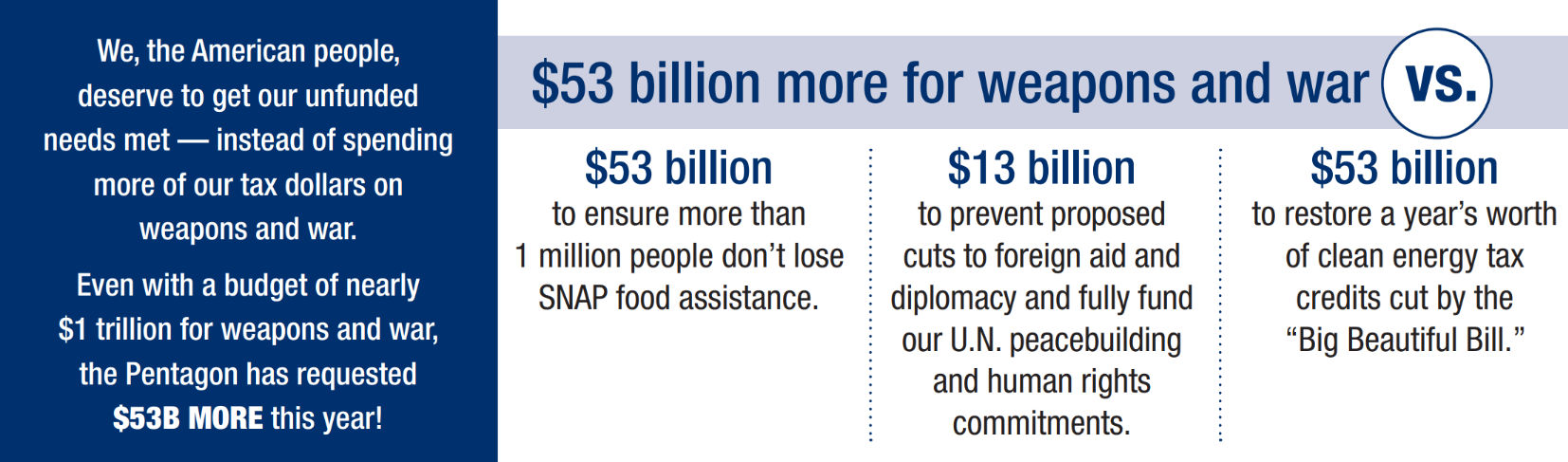
While $53 billion isn’t enough to close all of the gaps in funding for all the vital human needs programs that Congress and the administration have slashed, there are countless ways we can urge our leaders to redirect those dollars to help people, peace, and the planet. For just a few examples:
Provide Food for Hungry Children and Families: $53 billion to ensure more than 1 million people do not go hungry next year.
The Supplemental Nutrition Assistance Program (SNAP) supports more than 40 million people at risk of food insecurity. SNAP is the only nutrition assistance program under U.S. Department of Agriculture that serves all Americans, which means the enormous cuts from this year’s “One Big Beautiful Bill Act” (Public Law No: 119-21) will heighten hunger and poverty for poor and working individuals and families. The Urban Institute estimates that 22.3 million U.S. families will lose some or all of their SNAP benefits. This includes 3.3 million families with children and 5.2 million working families.
Over time, people will see their SNAP benefits reduced by an estimated $864 to $2,772 each year. Adding back $53 billion to the SNAP program could keep more than 1 million adults, children, and families receiving their full food assistance next year.

Restore Foreign Aid: $13 billion could ensure full funding for foreign aid and diplomacy.
This year, the House proposed eliminating several international economic development and humanitarian assistance accounts, and in doing so, is trying to fundamentally reshape how the United States engages with those in need around the world. At risk are initiatives that promote peace, support stability, and assist people in crisis. With just 25% of the $53 billion in extra funding for the Pentagon, Congress could protect funding for our nation’s dues to the United Nations, UNICEF, and the Office of the United Nations High Commissioner for Human Rights. It could also fully resource our dues to U.N. Peacekeeping, a vital measure for supporting global peace and stability.
That’s just the beginning. Congress could also fully fund UNRWA, the backbone of aid delivery for Palestinians in Gaza. UNRWA is currently receiving only half of what it needs each year. Likewise, international Atrocities Prevention is severely underfunded, currently providing resources to support efforts in just 3-5 countries – yet the 2022 U.S. Strategy to Anticipate, Prevent, and Respond to Atrocities asks for funding to address risks in up to 30 countries.
Re-allocating just 25% of the Pentagon’s unfunded wish list of $53 billion can help restore funding for peacebuilding and provide humanitarian assistance for people in war-ravaged areas.

Protect Climate Provisions, at Home and Abroad
The “One Big Beautiful Bill” gutted tax incentives and grants that fund clean energy projects across the country. With these tax increases, hundreds of climate projects will be eliminated, and as a result, U.S. energy bills are projected to rise an average of $400 per year in the next five years. The climate crisis is an emergency around the world, as well. Internationally, energy poverty increases the risk of inadequate nutrition, vulnerability to weather events, and constrained access to modern healthcare and education systems.
Meanwhile, the climate crisis is pushing 26 million more people into poverty each year across the globe, with a disproportional impact on developing nations.
Restoring $53 billion in investments in renewable energy can help address climate change, reduce energy costs, provide jobs here at home, and help developing communities.
As citizens, we have a say in how our tax dollars are spent. We believe our country’s investment of our money should reflect our values: supporting programs that reflect the dignity and worth of all people.
But right now, we are way, way off track. Congress and the White House are putting too much value on war at home and abroad, and not using enough resources on keeping families, communities, and the planet safe and healthy.
FCNL is putting our clear moral vision before lawmakers and calling on them to do the right thing by putting our tax dollars towards the People’s Unfunded Priorities, not more weapons and war.